Table of Contents
- Introduction — Why This Matters
- Background / Context
- Key Terms Explained
- How On-Device AI and Cloud AI Actually Compare
- Why Storage Is Shrinking: The Real Cause
- Why This Matters (Buyer Decision Factors)
- What to Expect Next
- Common Misconceptions
- Recent Developments (Last 6-12 Months)
- Real Buyer Scenarios
- Buying Tips for This Environment
- Conclusion and Final Verdict
- FAQs
- Where to Verify Prices & Specs
- Discussion
Introduction — Why This Matters
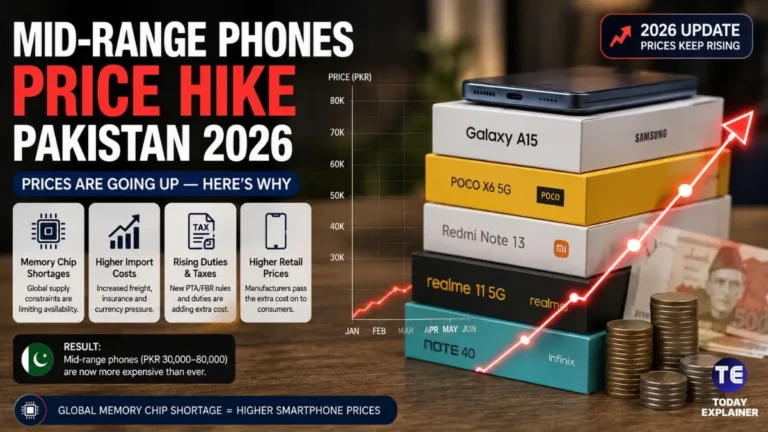
If you’ve shopped for a phone in Pakistan this year, you may have noticed something odd: the same money that got you 256GB of storage in 2025 might now only get you 128GB, and RAM configurations on budget models have quietly shrunk too. This isn’t a marketing gimmick or a random cost-cutting decision by one brand. It’s a global memory chip shortage, and it’s reshaping what phones look like from the inside out.
We researched official chipmakers and market-research data (TrendForce, Omdia, Counterpoint), current retail pricing trends, and how Apple, Samsung, Google, and Qualcomm are actually building their 2026 AI features to build this guide. According to TrendForce, overall smartphone bill-of-materials costs are expected to grow by an additional 5–7% or more in 2026 compared to 2025, driven almost entirely by memory chips — and Omdia’s Q1 2026 data found memory costs already account for nearly 60% of total component costs in smartphones priced below $400, and over 64% in phones under $99.
This guide explains what’s actually driving that shift, separates the real trend (a memory price crisis) from the exaggerated one (“the death of local storage”), and walks through what it means for your next phone’s storage, RAM, battery life, and monthly mobile data bill in Pakistan.
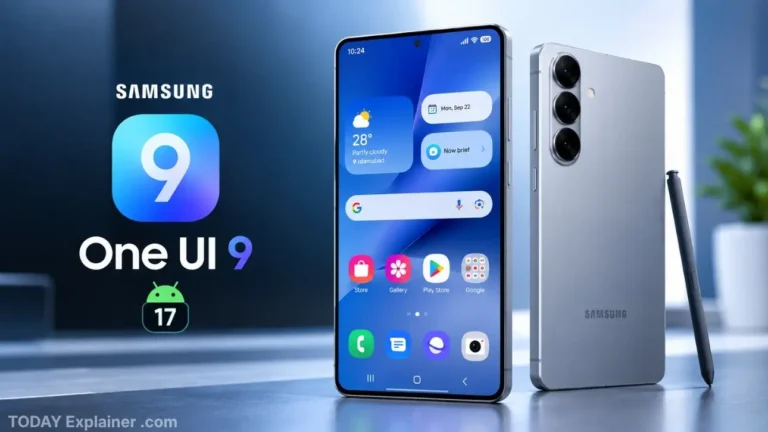
Quick Answer: Phone storage isn’t disappearing because of a deliberate move to cloud computing — it’s shrinking on budget devices because RAM and NAND flash chips got dramatically more expensive in 2026, largely due to AI data centers competing for the same memory supply. Flagship phones are going the opposite direction, adding more on-device AI processing power. The real shift for most buyers is a widening gap between what budget and premium phones can do locally.
Background / Context
For most of the last decade, phone storage only moved in one direction: up. 64GB became 128GB became 256GB as flash memory got cheaper every year. That trend broke in 2026.
Two things happened at once. First, generative AI adoption exploded, and data centers building out AI infrastructure started buying enormous quantities of the same DRAM and NAND flash chips that go into phones and laptops. Second, phone makers — who were already under margin pressure — had no easy way to absorb the sudden cost spike. According to TrendForce’s Q1 2026 tracking, Apple’s NAND pricing faced a quarter-on-quarter increase of up to roughly 100% in Q1 2026, while Android-camp NAND pricing rose nearly 80–90% in the same period, and the pressure continued into Q2. Counterpoint’s tracker separately found DRAM prices rose more than 50% quarter-over-quarter and NAND flash prices surged more than 90% in Q1 2026 alone.
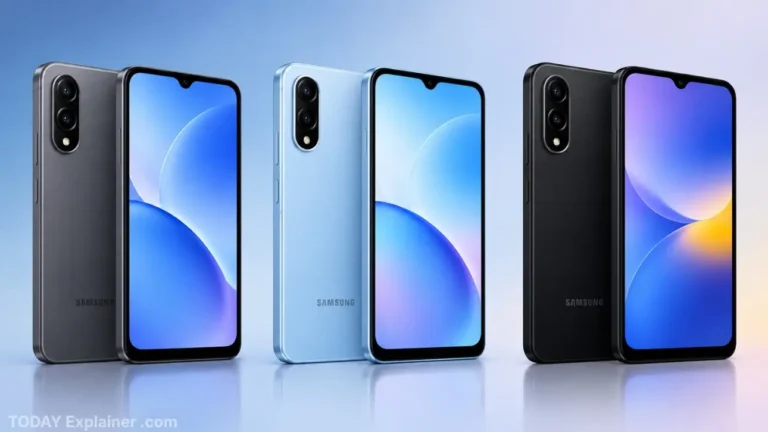
Brands responded in one of two ways. Some, like OPPO, explicitly cited rising memory hardware costs as the reason for a direct price hike. Others quietly kept prices the same but shipped less RAM or storage than the previous generation would have offered at that price point. Omdia’s research shows this split clearly by price tier: while global average phone memory capacity keeps rising overall, storage capacities in the budget and mid-range segments have actually decreased, even as premium phones continue getting more memory to justify their higher prices.
Why does this matter now, specifically for Pakistani buyers? Local retail prices track these global component costs closely, and Pakistan’s smartphone market skews heavily toward the budget and lower-mid tiers — exactly the segment absorbing the biggest storage cuts. At the same time, mobile data in Pakistan isn’t getting cheaper: PTA-approved tariff revisions this year pushed monthly call-and-data bundle prices up by as much as Rs 500, with some packages rising by as much as 33% year-over-year. If cheaper phones start leaning more heavily on cloud storage and cloud-based features to make up for smaller local storage, that leaning happens against a backdrop of data that’s also getting pricier — which is the real, grounded version of the “thick cloud” story.
Key Terms Explained
| Term | Simple Definition | Why It Matters for Buyers |
|---|---|---|
| DRAM | The chip that holds data your phone is actively using (this is your “RAM” number, e.g., 8GB) | Low DRAM means apps reload more often and multitasking feels sluggish |
| NAND Flash | The chip that permanently stores your photos, apps, and files (this is your “storage” number, e.g., 128GB) | Determines how much you can keep on the phone before you’re forced to delete or use cloud storage |
| NPU (Neural Processing Unit) | A dedicated chip component built specifically to run AI tasks efficiently on-device | More powerful NPUs mean faster, more private AI features that work without internet |
| On-device AI | AI processing that happens entirely on your phone’s own chip, with no data sent anywhere | Faster response, works offline, keeps your data on your phone |
| Cloud AI | AI processing that happens on remote servers, with your phone sending data over the internet and getting a result back | More powerful results for complex tasks, but needs a live internet connection and uses mobile data |
| Hybrid AI | A mix where simple tasks run on-device and heavy tasks are routed to the cloud automatically | This is how nearly all 2026 flagship phones actually work — not purely one or the other |
| BOM (Bill of Materials) cost | The total cost of all physical components inside a phone | When BOM costs rise (as with memory chips in 2026), brands either raise prices or cut specs to protect their margins |
| PTA approval | Registration of a phone’s IMEI with Pakistan’s telecom regulator, required for the SIM to work long-term | An unapproved phone will eventually lose mobile network access in Pakistan, regardless of how much storage it has |
How On-Device AI and Cloud AI Actually Compare
This is the part of the story that gets exaggerated the most. The popular framing is that manufacturers are “giving up” on local processing because components are too expensive, and pushing everything to the cloud instead. That’s not what’s happening. What’s actually happening is a hybrid split, and it’s getting more defined, not less.

Chipmakers are putting more AI-specific silicon into flagship processors every year, not less. Companies like Apple, Google, and Samsung are investing more in local AI processing, even as cloud providers simultaneously expand their own AI capabilities. The reason is straightforward: instant tasks like face unlock, typing suggestions, and basic photo adjustments need to feel immediate and need to work without a signal — something only on-device processing can guarantee. On-device AI handles speed, privacy, and offline capability, while cloud AI is reserved for complex reasoning, large language models, and capabilities that no phone chip can handle yet, such as advanced photo generation or long-form translation.
| Approach | Where It Runs | Works Offline | Data Usage | Best For |
|---|---|---|---|---|
| On-device AI | Phone’s own NPU/chip | Yes | None | Face unlock, typing prediction, basic camera AI |
| Cloud AI | Remote servers | No | Uses mobile data | Advanced translation, AI image generation, complex chatbots |
| Hybrid AI (most 2026 flagships) | Both, chosen automatically | Partially | Only for heavy tasks | Everyday use — balances speed, privacy, and capability |
So the honest framing isn’t “local storage is dying.” It’s this: premium phones are getting stronger at both — more on-device AI silicon and more cloud integration — while budget phones are being squeezed on the local side (less RAM, less storage) purely because the memory chips themselves cost more, which pushes cheaper devices to lean harder on cloud storage and cloud services to compensate.
Buying Tip: Don’t assume a phone with “AI features” in its marketing is doing more processing on the chip. Ask specifically whether a feature works with mobile data turned off. If it doesn’t, it’s a cloud feature, and it will use your data bundle every time you use it.

Why Storage Is Shrinking: The Real Cause
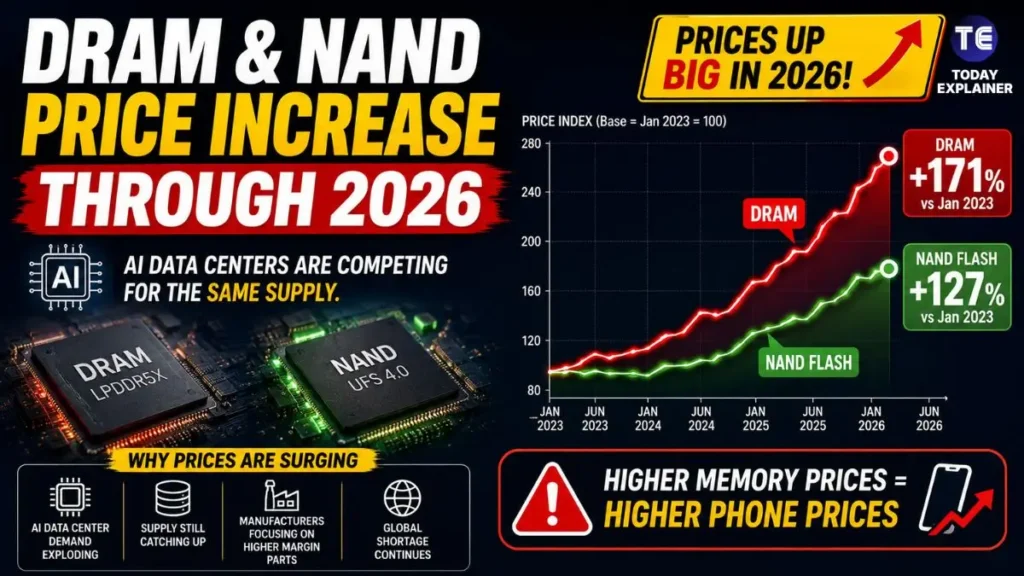
It’s worth being direct about this, because it’s the part most explainers get wrong: phone storage isn’t shrinking because manufacturers decided the cloud is better. It’s shrinking because the raw chips got dramatically more expensive, largely because of demand from somewhere else entirely — AI data centers.
Phone RAM (DRAM) and phone storage (NAND flash) use the same underlying chip families as the memory going into AI servers, laptops, and enterprise storage systems. When AI infrastructure spending accelerated in 2026, it pulled hard on the same global supply phone makers depend on. TrendForce’s analysis is blunt about the mechanism: memory is increasingly accounting for a larger share of BOM costs in consumer devices, and even Apple — which has strong profitability — saw its memory component costs in iPhones significantly increase in early 2026.
The effect isn’t evenly spread. Omdia’s research found that global smartphones priced below $400 are projected to decline by 22% in volume as memory costs squeeze that segment’s profitability, and separately that vendors are actively shrinking their budget-tier storage specs while continuing to boost memory in premium phones to justify higher prices. In other words, this is a story about polarization — cheap phones getting cheaper components, expensive phones getting more of everything — not a uniform industry-wide pivot away from local storage.
Why This Matters (Buyer Decision Factors)
Storage headroom for photos and videos. If you’re buying a budget phone this year, check the actual storage number carefully rather than assuming it matches last year’s equivalent price tier. A 128GB budget phone in 2026 may be doing the job a 256GB phone did at the same price a year earlier.
Cloud dependency and your data bundle. Some budget brands are compensating for smaller local storage by pushing cloud photo backup and cloud storage subscriptions harder. That’s a reasonable trade-off if you have a strong, affordable data plan — but in Pakistan, where most users pay roughly Rs 25–35 per GB on mobile networks and a decent home Wi-Fi bill still runs Rs 2,000–3,000 a month, leaning on the cloud for storage you’d otherwise keep locally has a real recurring cost.
Battery life and cloud AI features. Any AI feature that sends data to a server and waits for a response uses your radio (Wi-Fi or mobile network) more actively than a purely on-device task. This isn’t a dramatic battery killer for occasional use, but if a phone’s flashiest AI features are cloud-only, expect a modest but real battery cost with frequent use, on top of the data cost.

RAM and everyday multitasking. Lower RAM affects how many apps stay open in the background without reloading — a bigger day-to-day annoyance for most people than storage capacity itself. If a budget phone’s RAM has been trimmed compared to its predecessor, that’s often more noticeable in daily use than a smaller storage number.
Price stability. Because component costs are still moving, expect more mid-cycle price adjustments in 2026 than usual. A phone’s launch price is less “final” this year than in a typical year.
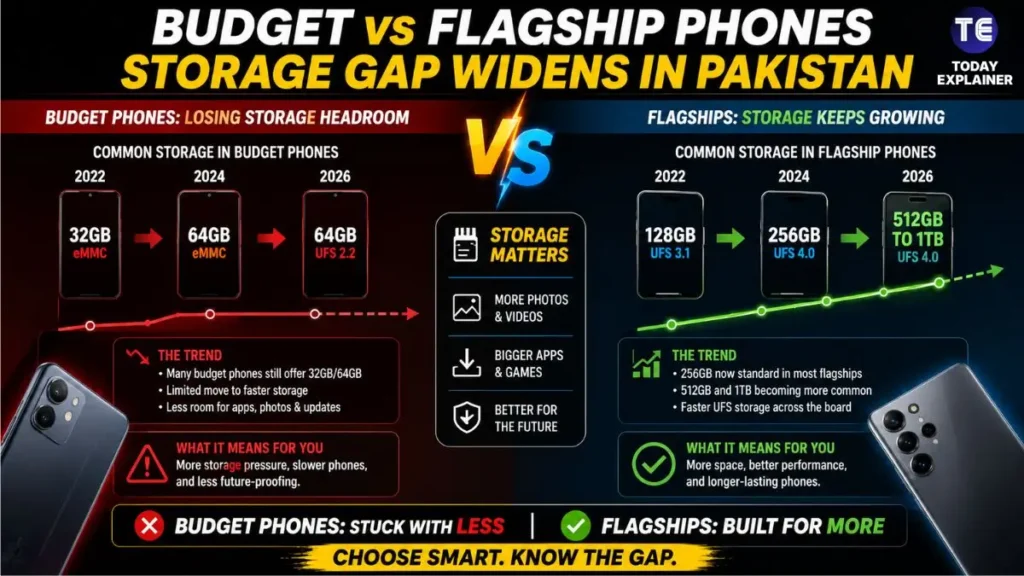
Buying Tip: When comparing two budget phones at a similar price, check RAM and storage generation-over-generation rather than just against each other. If a phone offers less than its own predecessor did a year ago at the same price, that’s the memory price crisis showing up directly in the spec sheet — not a design choice.
What to Expect Next
- Storage specs on budget phones will likely stay tight through 2026. TrendForce and Omdia both expect memory prices to remain elevated for at least several more quarters, so don’t expect a quick return to “more storage for the same money” at the low end.
- On-device AI will keep expanding on flagships, not shrinking. Expect 2026–2027 flagship chipsets to include even more dedicated AI processing hardware, with cloud AI reserved specifically for the heaviest tasks (large-scale image generation, deep research-style assistants), not for everyday features.
- Cloud storage bundling will likely increase on budget phones specifically, as brands look for ways to offset smaller local storage without raising prices further — worth checking whether any “free cloud storage” offer has a time limit before it starts charging you.
Common Misconceptions
Myth: Manufacturers are shifting AI processing to the cloud because local chips are too expensive. Reality: The opposite is largely true for AI processing — brands are adding more on-device AI hardware to flagships. The chips getting more expensive are RAM and storage, which is a separate issue from AI architecture.
Myth: A phone with less storage this year is a downgrade in quality. Reality: It often reflects the memory price spike hitting that price tier, not a deliberate feature cut. Check the rest of the spec sheet before assuming the phone is worse overall.
Myth: Cloud AI features always drain more battery than on-device ones. Reality: It depends on usage frequency. Occasional use of a cloud feature has a small battery impact; heavy daily use adds up more noticeably, mainly through radio (network) activity.
Myth: More RAM always means better performance. Reality: RAM helps with multitasking and keeping apps in memory, but chipset quality and software optimization matter just as much, sometimes more, for everyday speed.
Myth: Grey-market phones are just as safe a buy as PTA-approved ones, as long as the specs look good. Reality: An unapproved phone’s SIM functionality can be restricted or blocked over time in Pakistan, regardless of how much RAM or storage it has. Always confirm PTA status before buying.
Myth: Cloud storage is a free replacement for onboard storage. Reality: Most “free” cloud storage tiers are small, and ongoing plans cost money and require a live internet connection — plus mobile data if you’re not on Wi-Fi.

Myth: This memory price spike is a temporary blip that will reverse within a month or two. Reality: Market analysts currently expect elevated memory prices to persist for multiple quarters through 2026, not to snap back quickly.
Recent Developments (Last 6-12 Months)
- Late 2025: TrendForce first flagged that rising DRAM and NAND contract prices would push 2026 smartphone BOM costs up by 5–7% or more, prompting a downward revision of global smartphone production forecasts.
- Q1 2026: Counterpoint’s Memory Price Tracker recorded DRAM prices rising over 50% and NAND flash prices surging over 90% quarter-over-quarter, with memory reaching over 43% of total component cost on a common budget phone configuration.
- Early-to-mid 2026: OPPO became one of the first major brands to publicly announce price hikes explicitly citing rising memory component costs, a signal other brands quietly followed.
- Q2 2026: TrendForce data showed DRAM contract prices rising an expected 58–63% quarter-on-quarter and NAND flash prices rising 70–75%, with some phones “arriving with lower RAM or storage than expected” as a direct consequence.
- Mid-2026: Omdia’s Q1 2026 market analysis projected a 22% decline in global shipments of phones priced below $400 as memory costs squeezed that segment’s profitability, while confirming budget-tier storage specs are shrinking even as flagship specs keep growing.
- July 2026: Pakistan’s PTA approved updated tariff sheets showing mobile data and call package price increases of up to 33%, with monthly bundles becoming as much as Rs 500 more expensive — adding cost pressure on the mobile-data side just as some budget phones lean more on cloud services.
(Prices and figures last checked August 2026 and may shift as memory markets continue to move — always verify current figures before publishing or purchasing.)
Real Buyer Scenarios
The university student on a tight budget. She needs a reliable phone for online classes and note-taking, with a data bundle that has to stretch across a semester. For her, a budget phone that pushes photo backups to the cloud by default could quietly eat into her monthly data allowance — worth checking the phone’s default backup settings and switching heavy uploads to Wi-Fi-only before relying on it.

The small business owner upgrading from a 3-year-old phone. He’s comparing a mid-range 2026 phone against his old flagship and is confused why the new mid-ranger has less storage than his old one did. This is the memory price squeeze in action — his best move is prioritizing a phone with expandable storage (microSD) if he needs to keep large amounts of business files locally, since not every 2026 mid-range phone will out-spec a flagship from a few years earlier.
The content creator who shoots a lot of video. She needs heavy local storage and doesn’t want to depend on cloud uploads over mobile data while traveling. For her, a flagship-tier phone with strong on-device storage remains the safer bet in 2026’s market than a budget phone marketed around “cloud storage included,” since flagships are the segment where storage specs are still growing rather than shrinking.
Buying Tips for This Environment
- Compare RAM and storage against last year’s equivalent price tier, not just against competitors launching today — the memory price spike means “same price, less spec” is common in 2026.
- Check whether a phone’s headline AI features work offline. If a feature requires internet every time, budget for the data cost, not just the phone’s price.
- Confirm PTA approval status before buying, regardless of how the storage or AI specs look — this affects long-term SIM functionality, which matters more day-to-day than a few extra gigabytes.
- Look for expandable storage (microSD support) if you’re buying a budget phone and expect the built-in storage to feel tight — it’s an increasingly useful workaround given shrinking base storage at this tier.
- Read the fine print on “free cloud storage” offers bundled with budget phones — check the storage limit and how long the free period lasts before it converts to a paid plan.
- Buy from authorized retailers with proper warranty documentation, since grey-market pricing advantages don’t offset the risk of losing after-sales support on a device you’ll likely keep for several years given rising prices.
- Don’t assume “AI phone” marketing means more on-device processing. Ask directly, or check independent reviews, for which specific features run locally versus in the cloud.
Conclusion and Final Verdict
The real story in 2026 isn’t that phones are quietly giving up on local storage in favor of the cloud — it’s that memory chips got dramatically more expensive, largely because AI data centers are competing for the same supply, and that cost is landing hardest on budget and mid-range phones. Flagship phones are moving in the opposite direction, packing in more on-device AI hardware than ever. If there’s a “cloud shift” happening, it’s concentrated at the low end, where shrinking local storage is nudging cheaper phones toward cloud backup and cloud services — with a real, recurring mobile data cost attached in a market like Pakistan’s.

The Bottom Line: Treat the “everything’s moving to the cloud” headlines with some skepticism — the honest picture is a widening gap between budget phones (losing local storage to rising memory costs) and flagship phones (gaining more on-device AI power). Whichever tier you’re buying into, check the actual RAM and storage numbers against last year’s equivalent price point, confirm which AI features actually require an internet connection, and budget your mobile data accordingly.
FAQs
Q: Is local phone storage actually disappearing in 2026? A: No. It’s shrinking specifically on budget and mid-range phones due to rising memory chip costs, while flagship phones continue getting more storage and RAM.
Q: Why did RAM and storage get so much more expensive this year? A: DRAM and NAND flash chip prices surged largely because AI data centers are buying huge quantities of the same memory chips that go into phones, tightening global supply.
Q: Are manufacturers moving AI processing to the cloud to save money on chips? A: Not really — the trend for AI specifically is hybrid, with flagship brands adding more on-device AI hardware, not less. The chips getting squeezed are RAM/storage, a separate issue.
Q: Will a cloud-dependent phone use more of my mobile data? A: Yes, any AI or backup feature that sends data to a server uses your mobile data if you’re not on Wi-Fi, and Pakistan’s mobile data and package prices have risen this year too.
Q: Does cloud AI drain battery faster than on-device AI? A: Occasional use has a small impact, but frequent use of cloud-based features adds up through increased network activity, more than a phone doing the same task fully on-device.
Q: Should I buy a phone with less storage if the price is good? A: Compare it against what that price got you a year ago, and check for microSD expandability if you’ll need more local storage later — don’t assume it’s simply a worse phone.
Q: What’s the difference between on-device AI and cloud AI in plain terms? A: On-device AI runs directly on your phone’s chip and works offline; cloud AI sends your request to a remote server and needs an internet connection to respond.
Q: Is this memory price spike expected to end soon? A: Market analysts currently expect elevated prices to continue through multiple quarters of 2026, not resolve quickly.
Q: How much does mobile data cost in Pakistan right now? A: Most users pay roughly Rs 25–35 per GB within proper bundles, and PTA-approved tariff revisions this year raised some monthly packages by up to Rs 500.
Q: Does more RAM automatically mean a faster phone? A: Not necessarily — RAM helps with multitasking, but chipset quality and software optimization matter just as much for everyday speed.
Q: Are grey-market phones a safe way to get more storage for less money? A: Not recommended — PTA approval affects long-term SIM functionality regardless of the storage specs, and grey-market units typically come without proper warranty support.
Q: Which phones are least affected by the storage squeeze? A: Flagship-tier phones, where brands continue increasing memory specs to justify premium pricing rather than cutting them.
Q: What should I check before relying on a phone’s “free cloud storage” offer? A: The actual free storage limit and how long it lasts before converting to a paid subscription — these details vary a lot between brands.
Q: Can I add storage to a budget phone that has less built-in space? A: Only if it supports a microSD card — check this before buying if local storage headroom matters to you.
Q: Is 5G relevant to this storage and AI trend in Pakistan? A: Only partially — Pakistan’s 5G rollout is still limited to select zones in major cities, so most cloud-dependent features currently run over 4G/LTE-A for most users.
Where to Verify Prices & Specs
- GSMArena — for detailed, up-to-date phone specifications
- WhatMobile — for Pakistan-specific retail pricing on individual models
- PriceOye — for current Pakistani marketplace pricing comparisons
- PTA’s official website — for IMEI/PTA approval status and current mobile data tariff sheets
Discussion
- Have you noticed a recent phone offering less storage than its predecessor at the same price? What did you do — buy anyway, wait, or look at a different brand?
- If a budget phone leaned more heavily on cloud backup to make up for smaller storage, would that change your buying decision given current mobile data prices?
- For your own use — heavy photo/video storage, occasional AI features, or mostly everyday apps — does on-device storage or cloud storage matter more to you right now?