Table of Contents
- Introduction — Why This Matters
- Background / Context
- Key Specs & Terms Explained
- Comparison Table (All Phones Side-by-Side)
- Individual Breakdown
- Why This Matters (Buyer Decision Factors)
- What to Expect Next (Category Trends)
- Common Misconceptions
- Recent Developments (Last 6–12 Months)
- Real Buyer Scenarios
- Buying Tips for This Price Range
- Conclusion and Final Verdict
- FAQs
- Where to Verify Prices & Specs
- Discussion
Introduction — Why This Matters
For years, buying a phone in Pakistan meant a trade-off: a slim, comfortable phone with a battery that struggled past lunchtime, or a genuinely long-lasting phone that felt like a brick in your pocket. That trade-off is breaking down in 2026. We researched official specifications, current Pakistani retail prices, and verified user feedback to build this guide, and the pattern is clear — phones with 5,500mAh to over 7,000mAh batteries are now shipping in normal, everyday-slim bodies. Six of the top 10 best-selling smartphones with 6,000mAh-plus batteries globally in January 2026 used silicon-carbon (SiC) battery technology, and the average global smartphone battery capacity reached 5,291mAh in January 2026, up roughly 400mAh year-on-year — the biggest jump since 2021.
The reason is a change inside the battery itself, not a bigger battery compartment. This guide explains what a silicon-carbon battery actually is, which phones sold in Pakistan already use one, which major brands are still holding back, and what it should change about how you shop for your next phone.
Quick Answer: If a big, long-lasting battery in a normal-thickness phone is your priority, the OnePlus 13 (6,000mAh) and Xiaomi 15 (5,800mAh) are currently the strongest silicon-carbon options available in Pakistan at a realistic price, with the Honor Magic7 Pro (5,850mAh) close behind. Samsung and Apple have not adopted this battery type yet in their mainstream phones sold here.
Background / Context
Phone battery capacity had barely moved for almost a decade. Manufacturers hit a wall with the graphite anode used in standard lithium-ion cells — graphite simply can’t store much more energy per gram than it already does, so the only way to get a bigger battery was a physically bigger, heavier phone. That’s why so many “flagship” phones from 2019 to 2023 still shipped with 4,000–5,000mAh batteries despite screens, processors, and 5G radios all getting more power-hungry.
What’s changed going into 2026 is that Chinese manufacturers — Honor, Xiaomi, OnePlus, Oppo, vivo, and realme in particular — have moved silicon-carbon anode technology from lab demos into mass production at a cost that phone brands can absorb without a huge price jump. Most silicon-carbon battery phones now land in the 6,500 to 7,300mAh range, compared to the 4,500–5,000mAh that was standard in conventional lithium-ion flagships — a roughly 30 to 60 percent capacity increase without a matching increase in battery volume. The Honor Magic V6 foldable, shown at Mobile World Congress 2026, pushed this further with a 7,150mAh battery inside a foldable body that unfolds into a tablet-sized screen — a capacity larger than most non-folding phones carry.
For Pakistani buyers, this matters for a very practical reason: import costs and PTA tax already make flagship phones expensive here, so getting genuinely better battery life without needing an even bigger (and pricier) phone is one of the few “free” upgrades available this generation.
Key Specs & Terms Explained
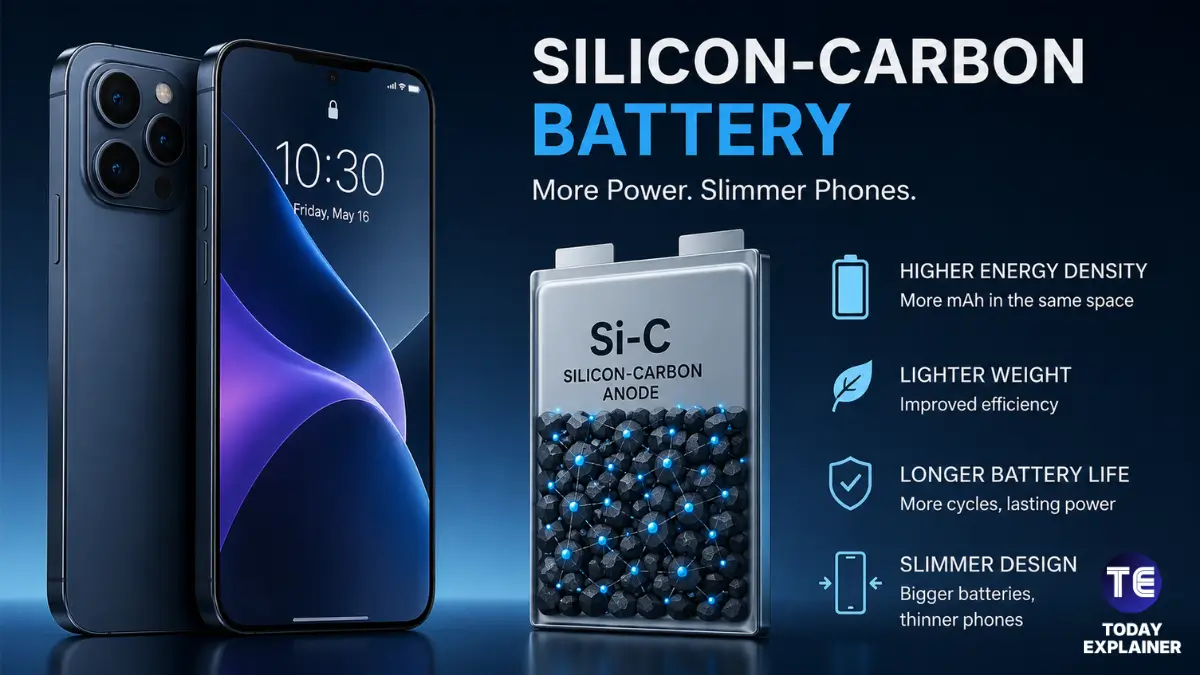
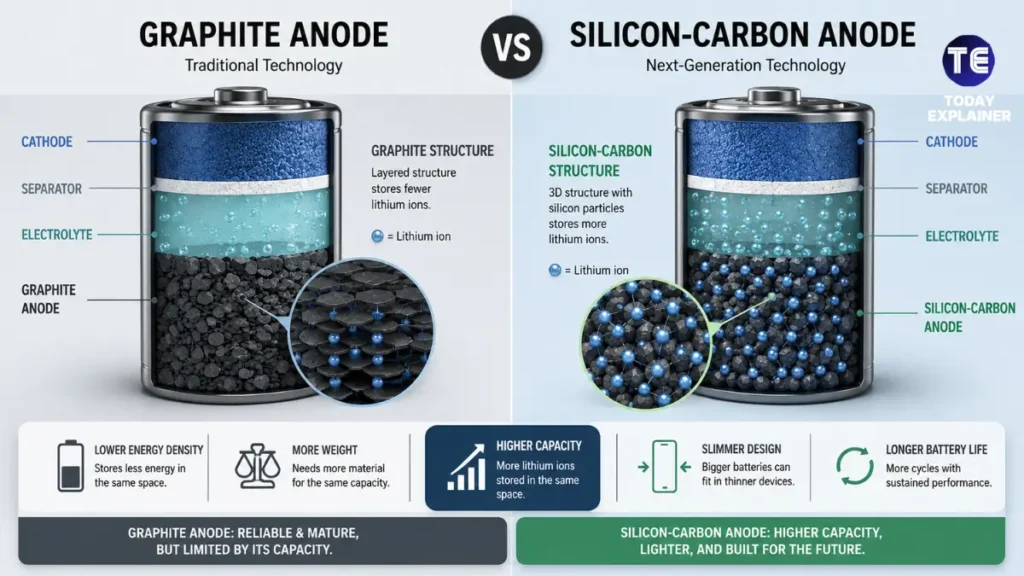
- Silicon-Carbon (Si/C) Anode: The negative electrode inside the battery, made from a silicon-carbon blend instead of pure graphite. Silicon can hold far more lithium ions in the same space, which is the core reason capacity goes up without the battery getting physically bigger.
- Energy Density: How much energy a battery stores per unit of volume or weight, usually measured in Wh/L (watt-hours per litre). A higher energy density battery packs more capacity into the same physical size.
- Anode: One of the two electrodes inside any battery (the other is the cathode). During charging, lithium ions move into the anode; during use, they move back out to power the phone.
- Silicon Swelling / Expansion: Silicon physically expands and contracts more than graphite as it absorbs and releases lithium ions. Early silicon batteries degraded faster because of this; 2026-generation cells manage it with better cell engineering and lower silicon percentages blended with carbon.
- mAh (Milliamp-Hour): The unit used to measure a battery’s total charge capacity. A higher number generally means more usable capacity, though real-world battery life also depends on the screen, chipset efficiency, and software.
- Fast Charging (Wired/Wireless Wattage): How quickly a battery can be recharged, measured in watts (W). Silicon-carbon batteries generally tolerate fast charging with less heat buildup than older graphite cells of the same capacity.
- Battery Health / Charging Cycles: How much capacity a battery retains after repeated full charge-discharge cycles. This is the main long-term question mark around silicon-carbon batteries, since the technology is newer and has less multi-year, real-world data than graphite.
- PTA Approval / DIRBS: Pakistan Telecommunication Authority’s registration system for imported phones. A non-PTA-approved phone will lose mobile network access after a grace period unless the DIRBS tax is paid — this matters because many silicon-carbon flagships enter Pakistan through import channels before or alongside official local launch.
| Term | Simple Definition | Why It Matters for Buyers |
|---|---|---|
| Silicon-Carbon Anode | Battery’s negative electrode made with a silicon-carbon blend instead of pure graphite | Lets phones pack more capacity into the same or smaller battery size |
| Energy Density | Energy stored per unit of volume (Wh/L) | Higher density means a bigger battery without a thicker phone |
| mAh | Unit measuring total battery capacity | Bigger number usually means longer use between charges |
| Fast Charging (W) | Speed at which the battery recharges | Determines how quickly you can top up before heading out |
| Battery Health/Cycles | Capacity retained after repeated charge cycles | Affects how long the phone lasts before you notice reduced battery life |
| PTA Approval/DIRBS | Government registration for phones used on Pakistani networks | Non-PTA phones lose network access unless tax is paid |
Comparison Table (All Phones/Options Side-by-Side)
Prices last checked August 2026 and may vary by retailer and city; PTA tax is separate for imported/non-PTA units.
| Phone | Price (PKR) | Display | Chipset | RAM/Storage | Camera | Battery |
|---|---|---|---|---|---|---|
| OnePlus 13 | ~PKR 209,999 (up to 250,000 for 24GB/1TB) | 6.82″ LTPO AMOLED, 120Hz | Snapdragon 8 Elite | 16GB/512GB (up to 24GB/1TB) | Triple 50MP (wide, ultrawide, telephoto) | 6,000mAh Si/C, 100W wired, 50W wireless |
| OnePlus 13s | ~PKR 164,999 (expected) | 6.32″ AMOLED, 120Hz | Snapdragon 8 Elite | 12GB/256GB–512GB | Dual 50MP | 5,850–6,260mAh Si/C, 80W wired |
| OnePlus 13T | ~PKR 180,000 | Compact AMOLED, 120Hz | Snapdragon 8 Elite | 12–16GB/256–512GB | Triple 50MP | 6,260mAh Si/C, 80W wired |
| Xiaomi 15 | PKR 269,999 | 6.36″ LTPO AMOLED, 120Hz | Snapdragon 8 Elite | 12–16GB/256GB–1TB | Leica triple 50MP | 5,800mAh Si/C, 90W wired, 50W wireless |
| Xiaomi 15 Ultra | PKR 383,999–399,999 | 6.73″ LTPO AMOLED, 120Hz | Snapdragon 8 Elite | 12–16GB/256GB–1TB | Leica quad (50MP+50MP+200MP+50MP) | 5,410–5,500mAh Si/C, 90W wired, 80W wireless |
| Honor Magic7 Pro | PKR 219,999–246,240 | 6.8″ LTPO OLED, 120Hz | Snapdragon 8 Elite | 12–16GB/512GB–1TB | 50MP+50MP+200MP telephoto | 5,850mAh Si/C (3rd-gen), 100W wired, 80W wireless |
Note: Several of these models reach Pakistan primarily through authorized importers rather than a full local retail launch, so exact configuration availability and price can shift week to week — always confirm the current listing before ordering.
Individual Breakdown
OnePlus 13 — The Big-Battery Standard-Bearer
- Price in Pakistan: PKR 209,999–250,000 depending on RAM/storage (prices vary by retailer/city and change frequently)
- Key Specs:
- 6.82″ LTPO AMOLED, 120Hz, 1440p
- Snapdragon 8 Elite chipset
- 6,000mAh silicon-carbon battery
- 100W wired charging (0–100% in ~25 minutes), 50W wireless
- Triple 50MP rear camera system
- What Stands Out: The OnePlus 13’s headline feature is its 6,000mAh battery built on a silicon-carbon anode, which gives it noticeably longer power backup than older flagships of a similar size. Charging is genuinely fast enough to go from empty to full during a short break.
- Where It Falls Short: No charger is included in the box, so factor in that extra cost, and it doesn’t have official local warranty support everywhere in Pakistan.
- Best For: Buyers who want the biggest available battery in a full-size flagship body without switching to a niche brand.
- Pros:
- Class-leading 6,000mAh capacity for the price
- Very fast 100W wired charging
- Strong all-round camera system
- Wireless charging included (rare at this price tier)
- Cons:
- No bundled charger
- Import-heavy availability in Pakistan means warranty terms vary by seller
- Large 6.82″ size won’t suit one-hand use
Xiaomi 15 — Compact Flagship With a Genuinely Big Battery
- Price in Pakistan: PKR 269,999 (prices vary by retailer/city and change frequently)
- Key Specs:
- 6.36″ LTPO AMOLED, 120Hz, 3,200 nits
- Snapdragon 8 Elite chipset
- 5,800mAh Si-Ca battery
- 90W wired HyperCharge, 50W wireless, 10W reverse wireless
- Leica triple 50MP camera with 8K video
- What Stands Out:The 5,800mAh silicon-carbon battery comfortably lasts a full day of intensive use, and the 90W wired HyperCharge fills it to 100% in approximately 35 minutes, which is unusual for a phone this compact. IP68 water resistance is included too.
- Where It Falls Short: It sits close in price to the larger Xiaomi 15 Ultra, so buyers chasing camera zoom range specifically may find the standard 15 a step down in telephoto reach.
- Best For: Buyers who want flagship battery life without carrying a 6.7″+ phone.
- Pros:
- Compact size with a big-phone battery
- Fast, well-balanced charging (wired + wireless + reverse wireless)
- IP68 rating
- Leica-tuned camera system
- Cons:
- Premium pricing close to larger flagships
- HyperOS software has a learning curve for switchers from stock Android
Xiaomi 15 Ultra — Camera-First Flagship, Still Silicon-Carbon Inside
- Price in Pakistan: PKR 383,999–399,999 (prices vary by retailer/city and change frequently)
- Key Specs:
- 6.73″ LTPO AMOLED, 120Hz
- Snapdragon 8 Elite chipset
- ~5,410–5,500mAh Si/C battery (listings vary by market variant)
- 90W wired, 80W wireless charging
- Leica quad camera: 50MP main, 50MP ultrawide, 200MP periscope telephoto, 50MP telephoto
- What Stands Out: This is Xiaomi’s camera-focused halo phone, and the silicon-carbon cell means the huge periscope camera module didn’t force a battery downgrade to fit — a trade-off older flagships regularly made.
- Where It Falls Short: At this price it’s competing directly with Samsung’s Ultra line and imported iPhone Pro Max units, and its battery capacity is actually smaller than the cheaper Xiaomi 15 and OnePlus 13.
- Best For: Photography-focused buyers who want zoom versatility and are willing to pay a premium for it.
- Pros:
- Best-in-class zoom camera system
- Fast 90W/80W wired and wireless charging
- Premium build and display
- Cons:
- Very high price for the Pakistani market
- Battery capacity is smaller than cheaper siblings in the same lineup
- Heavy and large in daily use
Honor Magic7 Pro — Third-Generation Silicon-Carbon Cell
- Price in Pakistan: PKR 219,999–246,240 depending on seller (prices vary by retailer/city and change frequently)
- Key Specs:
- 6.8″ LTPO OLED, 120Hz, up to 5,000 nits peak
- Snapdragon 8 Elite chipset
- 5,850mAh (typical), 5,750mAh (rated) third-generation silicon-carbon battery
- 100W wired HONOR SuperCharge, 80W wireless
- 50MP main + 50MP ultrawide + 200MP telephoto (3x optical, 100x digital)
- What Stands Out: The battery is explicitly listed as a third-generation silicon-carbon design. and Honor pairs it with genuinely fast 100W wired and 80W wireless charging — a combination few competitors match at this price.
- Where It Falls Short: Battery capacity can vary by region, so Pakistani buyers should confirm which imported variant they’re actually getting, and PTA tax on imported units adds a significant amount to the final cost.
- Best For: Buyers who want Samsung Ultra-level camera zoom and display quality at a lower entry price, and don’t mind buying an imported unit.
- Pros:
- Fast 100W wired + 80W wireless charging together
- Strong zoom camera hardware
- Bright, comfortable LTPO display
- Cons:
- Regional battery/spec variance requires careful checking before purchase
- No widespread official local warranty network in Pakistan
- PTA tax on imported units is substantial
Why This Matters (Buyer Decision Factors)
Battery Capacity Isn’t the Whole Story
A 6,000mAh silicon-carbon battery in an efficient phone can outlast a 5,000mAh battery in a power-hungry one. Chipset efficiency, display resolution, and refresh-rate management all affect real-world endurance as much as raw capacity does.
Charging Speed vs. Long-Term Battery Health
Very fast charging (90–100W) is convenient, but repeated high-speed charging generates more heat, and heat is the main long-term enemy of any lithium battery, silicon-carbon included. Phones that manage charging temperature well tend to hold capacity better after a year or two of daily use.
Buying Tip: Don’t just compare the mAh number on the spec sheet. Check whether the phone supports adaptive or “protected” charging modes (often buried in battery settings) — these slow down charging once you’re near 100% or during overnight charging, which meaningfully extends long-term battery health.
Import Status and PTA Tax Change the Real Price
Several of the phones in this guide reach Pakistan mainly through import channels rather than a full official local launch. That means the sticker price you see online often doesn’t include PTA/DIRBS registration tax, which can add tens of thousands of rupees depending on the phone’s declared value.
Thinness vs. Durability Trade-offs
Silicon-carbon batteries let manufacturers make phones thinner without sacrificing capacity — but a thinner chassis can also mean less structural rigidity and a smaller physical buffer for heat dissipation during sustained gaming. It’s worth checking independent thermal-throttling reviews, not just the spec sheet, before assuming “thin and big battery” also means “cool under load.”
Resale Value and Local Support
Officially imported or grey-market flagships generally have weaker local warranty and resale support than phones sold through a brand’s official Pakistani retail presence. This matters more the more expensive the phone is.
What to Expect Next (Category Trends)
- Samsung is expected to be a late adopter. Samsung has confirmed it is evaluating silicon-carbon battery technology, but the Galaxy S26 Ultra launched in early 2026 continued a seven-year pattern of shipping with a 5,000mAh battery, unchanged since the Galaxy S20 Ultra. Industry reports suggest Samsung devices may adopt silicon-carbon cells in late 2026 or 2027, though the company hasn’t made a public commitment.
- Apple has stayed silent on the technology. Apple has not adopted silicon-carbon battery technology in any shipping product, and analysts expect adoption — if it happens — around the iPhone 18 or 19 cycle, though Apple’s usual secrecy makes this hard to predict with confidence.
- The technology is moving down-market fast. What started in ultra-premium flagships in 2024–2025 is now appearing in mid-range phones too, which should push genuinely long-lasting batteries into the PKR 60,000–100,000 bracket within the next year or two.
Common Misconceptions
Myth: A silicon-carbon battery is a completely different, exotic battery type. Reality: It’s still a lithium-ion battery. Only the anode material changes — from graphite to a silicon-carbon blend — which is why it works with your existing charger and cables.
Myth: A bigger mAh number always means longer battery life. Reality: Screen size and resolution, chipset efficiency, and 5G usage all affect real-world battery life. A smaller, well-optimized battery can outlast a larger, inefficient one.
Myth: Silicon-carbon batteries degrade faster than normal batteries. Reality: Early silicon-heavy experimental batteries did have swelling and degradation problems. 2026-generation silicon-carbon cells use a much lower percentage of silicon blended with carbon and improved cell engineering, which has largely addressed the early swelling issues — though long-term, multi-year data is still more limited than for graphite cells.
Myth: Grey-market or non-PTA phones are just as safe to buy as PTA-approved ones. Reality: A non-PTA phone will eventually lose mobile network access unless you pay the DIRBS tax, and you typically get no official local warranty support — the upfront savings can disappear quickly.
Myth: All flagship phones in 2026 already use silicon-carbon batteries. Reality: Adoption is uneven. Chinese brands (Honor, Xiaomi, OnePlus, Oppo, vivo, realme) have moved fastest, while Samsung and Apple have not adopted the technology in their mainstream lineups sold in Pakistan as of mid-2026.
Myth: Fast charging is bad for any battery, silicon-carbon included. Reality: Fast charging generates more heat, which matters over years of use, but modern phones manage this with smart charging curves. The bigger risk factor is consistently charging in hot environments or leaving the phone plugged in at 100% overnight without a protection feature enabled.
Myth: You need to buy the most expensive flagship to get a silicon-carbon battery. Reality: The technology has already reached the upper-mid-range in several markets, and it’s expected to filter into more affordable phones sold in Pakistan over the next one to two years.
Recent Developments (Last 6–12 Months)
- January 2026: Six of the top 10 best-selling smartphones globally with 6,000mAh-plus batteries used silicon-carbon technology, with Chinese OEMs (vivo, Xiaomi, Oppo, Honor) capturing every spot in that top-10 list.
- Early 2026: The Honor Magic V6 foldable was announced at Mobile World Congress 2026 with a 7,150mAh silicon-carbon battery inside a foldable, tablet-unfolding body.
- Early 2026: Samsung’s Galaxy S26 Ultra launched still using a conventional 5,000mAh battery, the same capacity the Ultra line has used since the Galaxy S20 Ultra, keeping Samsung a step behind the silicon-carbon shift.
- Throughout 2026: OnePlus expanded its silicon-carbon lineup in Pakistan beyond the OnePlus 13 to include the compact OnePlus 13s (5,850–6,260mAh) and OnePlus 13T (6,260mAh), both aimed at buyers who want big batteries in smaller bodies.
- 2026: Xiaomi’s HyperOS-based 15-series continued shipping Si-Ca batteries across the range, from the standard Xiaomi 15 (5,800mAh) up through the camera-focused 15 Ultra, pairing the cells with 90W+ wired charging.
- Ongoing: Pakistani retail prices for these phones continue to fluctuate with the PKR-to-USD exchange rate and PTA tax adjustments, so listed prices should always be checked against current dealer listings before purchase.
Real Buyer Scenarios
The frequent traveller who hates carrying a power bank. Someone regularly on flights, long bus rides between cities, or in areas with inconsistent power needs a phone that survives a full day of maps, calls, and hotspot use without hunting for an outlet. The OnePlus 13’s 6,000mAh silicon-carbon battery and fast 100W charging make it a strong fit — quick top-ups between long stretches of heavy use.
The content creator juggling camera and video work. Someone shooting and editing video on their phone for social media needs both a capable camera system and a battery that survives hours of screen-on editing time. The Xiaomi 15 Ultra’s combination of a versatile Leica camera setup and a fast-charging silicon-carbon cell suits this kind of heavy, camera-app-intensive workload, even though its raw capacity is smaller than some rivals.
The budget-conscious buyer upgrading from a 4 year old phone. Someone replacing an aging phone whose battery barely lasts half a day wants a noticeable, reliable improvement without stepping into ultra-premium pricing. The Honor Magic7 Pro, at a lower price than the Xiaomi and OnePlus ultra-flagships, offers a large silicon-carbon battery and fast charging while staying comparatively more affordable — provided the buyer carefully checks PTA import tax before committing.
These are illustrative buyer profiles to help match phone features to different needs, not real customer testimonials.
Buying Tips for This Price Range
- Always check PTA approval status before paying. An unregistered phone will lose network access after the grace period unless DIRBS tax is paid — factor this into your real budget, not just the sticker price.
- Confirm which regional variant you’re buying. Battery capacity and chipset details can differ between the China, Global, and India variants of the same phone name — ask the seller specifically which version is in stock.
- Buy from an authorized local retailer or reputable importer with a track record, not an unverified online marketplace listing, especially for phones in the PKR 150,000+ range.
- Check the IMEI before paying, ideally in person, to confirm it matches the box and hasn’t been blacklisted.
- Ask about local warranty coverage explicitly. Many of these phones enter Pakistan without full official brand warranty support — a seller-provided warranty is not the same thing.
- Don’t assume the biggest mAh number is automatically the best choice — match battery size to your actual screen-on-time habits and how much you use 5G, GPS, and camera features daily.
- If a deal seems significantly cheaper than every other listing, treat it as a red flag, not a bargain — verify the seller’s reputation and return policy first.
Conclusion and Final Verdict
Best overall for battery capacity: OnePlus 13, thanks to its 6,000mAh silicon-carbon cell and 100W charging in a still-manageable flagship body.
Best for compact-phone battery life: Xiaomi 15, which fits a 5,800mAh battery into a 6.36″ body without asking buyers to compromise on charging speed.

Best camera-first pick that still has a strong battery: Xiaomi 15 Ultra, for buyers prioritizing zoom photography who don’t want to sacrifice battery performance to get it.
Best value entry into silicon-carbon flagships: Honor Magic7 Pro, offering a large battery and very fast charging at a lower price point than its Xiaomi and OnePlus rivals — with the caveat of checking import/PTA costs carefully.
The Bottom Line: Silicon-carbon batteries are a genuine, meaningful upgrade — not marketing spin — and in 2026 they’re concentrated in phones from Honor, Xiaomi, and OnePlus rather than spread evenly across the market. If a long-lasting battery in a normal-thickness phone matters to you, these three brands are currently your strongest options in Pakistan, while Samsung and Apple buyers will likely need to wait at least until 2027 for the same technology in their preferred ecosystem.
FAQs
Q: What exactly is a silicon-carbon battery? A: It’s a lithium-ion battery where the anode uses a silicon-carbon blend instead of pure graphite. Silicon holds more lithium ions in the same space, which raises the battery’s energy density and lets phones fit a bigger capacity into the same or smaller physical size.
Q: Is a silicon-carbon battery safe? A: Yes, when properly engineered — it uses the same lithium-ion chemistry and safety protections as any modern phone battery. Early experimental silicon batteries had swelling issues, but 2026-generation cells use lower silicon percentages and better cell engineering to manage this.
Q: Do silicon-carbon batteries charge faster than regular batteries? A: The battery chemistry itself doesn’t determine charging speed on its own — the phone’s charging circuitry does — but silicon-carbon cells generally tolerate high-wattage fast charging with less heat buildup than older graphite cells of comparable capacity.

Q: Which phones in Pakistan currently have silicon-carbon batteries? A: The OnePlus 13, 13s, and 13T; the Xiaomi 15 and 15 Ultra; and the Honor Magic7 Pro are among the most widely available silicon-carbon battery phones in the Pakistani market as of mid-2026.
Q: Does Samsung use silicon-carbon batteries? A: Not yet in its mainstream lineup. The Galaxy S26 Ultra launched in early 2026 with a conventional 5,000mAh battery, the same capacity Samsung’s Ultra line has used since 2020, though the company says it is evaluating the technology.
Q: Does the iPhone use a silicon-carbon battery? A: No. Apple has not adopted silicon-carbon battery technology in any shipping iPhone as of mid-2026, and the company has not publicly committed to a timeline.
Q: Will silicon-carbon batteries degrade faster over time? A: Current-generation silicon-carbon cells are engineered to avoid the rapid degradation seen in early experimental silicon batteries, but because the technology is newer, there’s less multi-year, real-world degradation data compared to standard graphite lithium-ion batteries.
Q: Are silicon-carbon battery phones more expensive? A: Not necessarily because of the battery alone — pricing depends more on the overall phone tier (flagship vs. mid-range) than the battery chemistry specifically, and the technology is already spreading into more affordable segments.
Q: What does PTA approval mean, and why does it matter for these phones? A: PTA (Pakistan Telecommunication Authority) approval registers a phone’s IMEI for use on Pakistani mobile networks. Many silicon-carbon flagships enter Pakistan through import channels, so buyers should confirm PTA status and factor in DIRBS tax before purchase.
Q: Can I still use a non-PTA-approved phone with WiFi only? A: Yes, WiFi-only functions typically aren’t affected, but you’ll lose the ability to use a local SIM card for calls and mobile data once the grace period ends without registration.
Q: How much bigger are silicon-carbon batteries compared to older flagship batteries? A: Many current silicon-carbon flagships carry batteries in the 5,800–6,260mAh range, meaningfully larger than the 4,500–5,000mAh that was standard in graphite-based flagships just a couple of years earlier.
Q: Is a bigger battery always better? A: Not automatically — chipset efficiency, screen resolution, and how you use the phone (heavy gaming vs. light browsing) affect real-world battery life as much as raw capacity does.
Q: Should I wait for Samsung or Apple to adopt silicon-carbon batteries before upgrading? A: That depends on your ecosystem preference and how urgently you need a new phone. If battery life is your top priority and you’re not tied to iOS or Samsung’s One UI, current Chinese-brand flagships already offer the technology; if you specifically want it in an iPhone or Galaxy, expect to wait until at least 2027.
Q: Do these phones support wireless charging? A: Most of the flagship-tier silicon-carbon phones covered here do — the OnePlus 13, Xiaomi 15 series, and Honor Magic7 Pro all include wireless charging alongside fast wired charging.
Q: Where can I check the most current price for these phones in Pakistan? A: Prices change frequently due to exchange rate shifts and import costs, so always check current listings on official brand sites and established Pakistani price-tracking platforms rather than relying on older articles or screenshots.
Where to Verify Prices & Specs
- GSMArena — for detailed, brand-independent phone specifications
- Official brand websites (OnePlus, Xiaomi, Honor) — for confirmed regional specs and official pricing where available
- PriceOye — for current Pakistani retail price tracking across multiple sellers
- WhatMobile — for Pakistan-specific pricing, PTA tax estimates, and local availability
Discussion
- Are you prioritizing raw battery capacity or overall phone size when choosing your next upgrade — and has that changed now that big batteries no longer mean bulky phones?
- If you’ve bought an imported silicon-carbon flagship in Pakistan, how much did PTA tax actually add to your total cost, and did it change which phone you chose?
- Would you wait for Samsung or Apple to adopt silicon-carbon batteries, or switch ecosystems now for the battery life improvement? Let us know in the comments.