Table of Contents
- Introduction — Why This Matters
- Background / Context
- Key Terms Explained
- Brand-by-Brand Price Hike Snapshot
- Individual Breakdown
- Why This Matters (Buyer Decision Factors)
- What to Expect Next
- Common Misconceptions
- Recent Developments
- Real Buyer Scenarios
- Buying Tips During a Price-Hike Cycle
- Conclusion and Final Verdict
- FAQs
- Where to Verify Prices & Specs
- Discussion
Introduction — Why This Matters
If you’ve been putting off a phone upgrade this year, you’ve probably noticed something odd: the phone you were eyeing six months ago either costs more now or quietly ships with less RAM and storage than the model it replaced. That’s not a coincidence, and it’s not just a problem in Pakistan. We researched official manufacturer statements, industry analyst data from TrendForce and Counterpoint Research, and Pakistan Telecommunication Authority (PTA) figures to build this explainer on what’s actually happening.
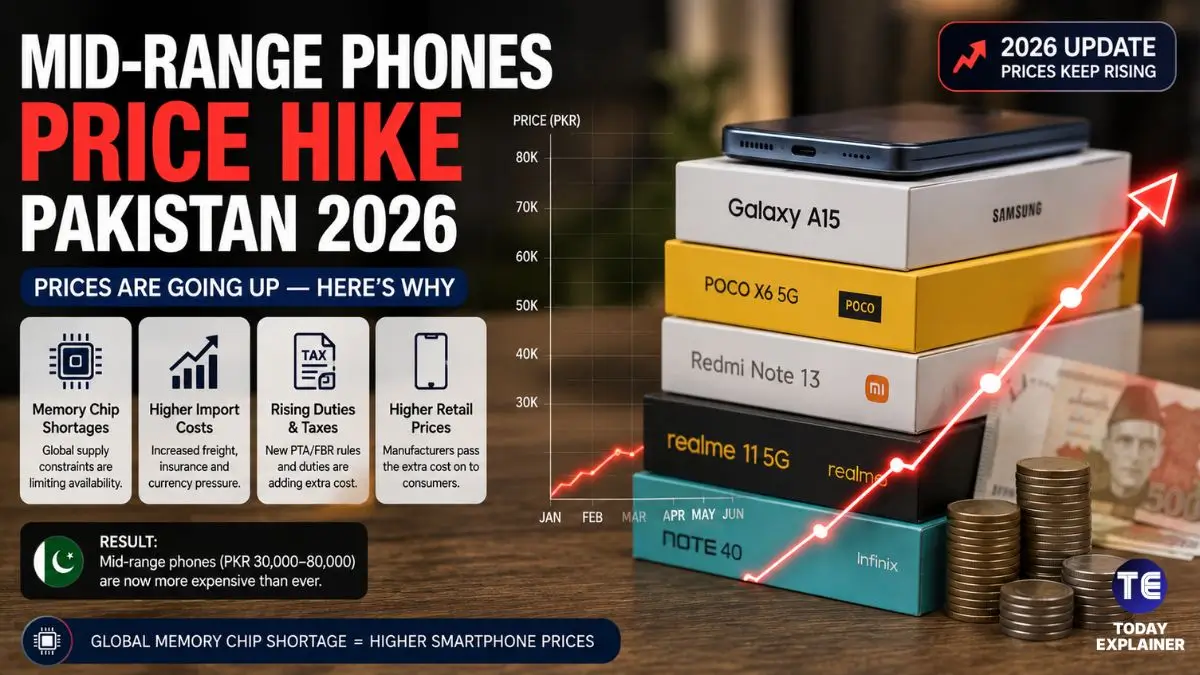
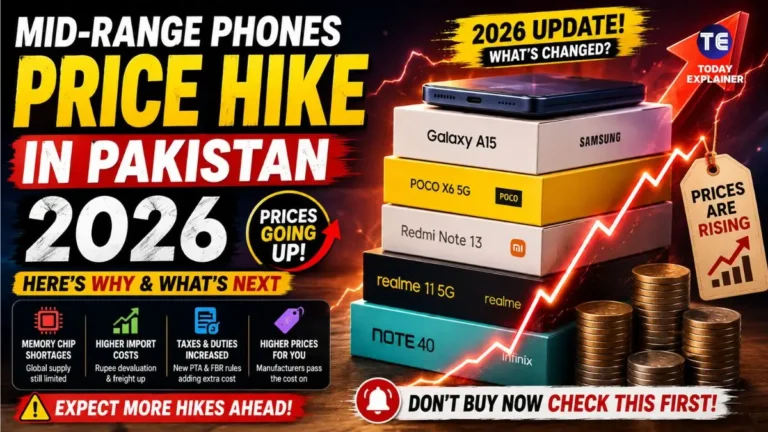
The short version: the memory chips inside every smartphone — DRAM and NAND flash — have gone through one of the sharpest price increases the industry has ever tracked, driven largely by the same AI data centre boom you’ve read about in tech news all year. Global smartphone shipments are now projected to fall by roughly 12.9% in 2026, and the segment taking the hardest hit is exactly the one most Pakistani buyers shop in: the budget and mid-range tier.
This article breaks down what’s driving the price hikes, how brands like Xiaomi and Huawei have responded, what it means for the “budget flagship” phones that used to offer flagship specs at a discount, and what you should actually do if you need a new phone right now.
Quick Answer: Component costs — especially memory chips — have risen so sharply in 2026 that most brands can no longer offer flagship-level specs at budget-flagship prices. If you don’t need to upgrade immediately, waiting for Q4 2026 or early 2027 price stabilization is the financially smarter move; if you must buy now, prioritize a locally assembled, PTA-approved mid-ranger over an imported “deal” that may be running outdated stock at an inflated price.
Background / Context
For most of the last decade, the phone industry ran on a predictable rhythm: chipsets got faster, memory got cheaper per gigabyte, and brands like Xiaomi, Redmi, Infinix, and Tecno used that falling cost curve to push more RAM and storage into cheaper phones every year. That rhythm broke in 2025 and has gotten dramatically worse through 2026.
The reason is not a repeat of the 2021 pandemic-era chip shortage, where factory shutdowns and shipping disruptions caused a temporary supply crunch that eventually resolved. This time, the shortage is demand-driven: memory manufacturers like Samsung, SK Hynix, and Micron are redirecting wafer capacity toward high-bandwidth memory (HBM) for AI servers, because that business is far more profitable than supplying standard DRAM and NAND for phones and laptops. TrendForce projects the global memory market will grow from roughly $551.6 billion in 2026 to $842.7 billion in 2027 — but that revenue growth is coming from price increases, not from more memory actually reaching consumer devices. The volume going into phones and PCs is shrinking even as the dollar value of the memory market explodes.

For Pakistani buyers, this collides with a separate set of local pressures. The rupee’s exchange rate against the dollar directly affects import costs, since the vast majority of smartphones sold here are either fully imported or assembled locally using imported components. On top of that, Pakistan’s new Mobile and Electronic Devices Manufacturing Policy 2026-33 introduced a ban on importing used mobile phones — removing a budget option that many lower-income buyers previously relied on — while local assemblers, who make up a large share of the domestic market, are just as exposed to global memory price spikes as anyone importing a finished device. PTA data compiled by Topline Securities showed local mobile manufacturing and assembly fell 35% month-on-month in April 2026 alone, a sign that even the domestic industry is scaling back production in response to costs.
Key Terms Explained
Before going further, here are the terms you’ll see repeated in every article about this crunch — including this one.
| Term | Simple Definition | Why It Matters for Buyers |
|---|---|---|
| DRAM | The short-term memory (RAM) a phone uses to run apps and switch between them | DRAM prices have risen the fastest of any phone component in 2026, directly pushing up retail prices |
| NAND Flash | The long-term storage chip that holds your photos, apps, and files | NAND price increases have, in some quarters, outpaced even DRAM, making higher storage tiers disproportionately expensive |
| BOM (Bill of Materials) | The total cost of every physical component that goes into building one phone | When BOM rises, brands either raise the price, cut a spec, or shrink their profit margin — there’s no fourth option |
| HBM (High-Bandwidth Memory) | A premium, high-speed memory type used mainly in AI servers, not phones | HBM demand is the root cause of the shortage — it’s pulling factory capacity away from the DRAM/NAND phones need |
| Spec downgrade | Shipping a new phone model with less RAM/storage than its predecessor, often at the same price | This is how many brands are quietly absorbing cost increases without technically “raising the price” |
| Budget flagship | A phone priced in the mid-range that offers near-flagship specs (fast chipset, good camera, high refresh-rate display) | This category is the one being squeezed hardest, since it depended on thin margins that memory costs have now erased |
| Contract price (memory) | The price manufacturers negotiate with chip suppliers, as opposed to spot-market pricing | Contract prices lock brands into cost increases for months at a time — they can’t simply wait out a bad quarter |
| PTA approval | Pakistan Telecommunication Authority registration required for any phone to work on local SIM networks long-term | Non-PTA “grey market” phones look cheaper on paper but come with real network and resale risk, which matters more when budgets are tight |
Brand-by-Brand Price Hike Snapshot
The table below summarizes how major brands relevant to Pakistani buyers have responded through 2026. Figures are drawn from company statements and industry reporting (TrendForce, Counterpoint Research, Digitimes, and BigGo Finance); China-market yuan figures are included where that’s the primary market affected, since those adjustments tend to filter into regional and Pakistani pricing over subsequent months.

| Brand | 2026 Price Action | Segment Hit Hardest | Stated/Reported Driver |
|---|---|---|---|
| Xiaomi | Three separate 2026 price increases on Redmi Turbo, K90, and Xiaomi 17 series (roughly CNY 300–500 per model) | Redmi and POCO mid-range lines | Rising DRAM/NAND contract costs cited directly in Xiaomi’s pricing communications |
| Huawei | Company-wide price increase across smartphones and tablets effective July 1, 2026 | Nova series (entry and mid-tier) | Executive Richard Yu publicly warned memory costs are pushing manufacturers toward losses |
| Samsung | Regional price increases on the A-series and flagship Ultra models (e.g., roughly ₩100,000 added to the Galaxy S26 Ultra in South Korea) | A-series (budget/mid-range) | Memory and component cost pass-through, confirmed via regional retail pricing |
| Apple | Held pricing broadly flat; iPhone 17e kept its price while doubling base storage | Least affected — flagship margins absorb the increase | Apple’s scale gives it stronger negotiating leverage on memory supply contracts |
| Local Pakistani assemblers (Infinix, Tecno, and others) | Indirect price pressure; local manufacturing output fell 35% month-on-month in April 2026 per PTA-linked data | Entry-level and locally assembled mid-rangers | Reliance on imported memory chips despite local assembly; rupee depreciation compounds the effect |
Prices last checked August 2026 and may vary by retailer, city, and ongoing currency movement.
Individual Breakdown
Xiaomi — The Budget Flagship Pioneer Under the Most Pressure
- What’s changed: Xiaomi confirmed its third round of 2026 price adjustments on its flagship and Redmi lines, with per-model increases in the CNY 300–500 range domestically, alongside regional adjustments (for example, an added ₩200,000 — roughly $145 — on the Xiaomi 17 Ultra in South Korea).
- What stands out: Xiaomi has tried to protect its most visible flagship pricing while quietly passing more of the cost increase onto Redmi and POCO, the lines that built its reputation for “flagship specs at a budget price” in markets like Pakistan.
- Where it falls short: Analysts note Xiaomi’s memory costs for a typical mid-range configuration (8GB RAM/256GB storage) rose meaningfully entering 2026, and that pressure is landing squarely on the sub-PKR-60,000 segment Pakistani buyers shop in most.
- Best for: Buyers who can wait, or who are comfortable stepping down one storage tier from what they originally planned to buy.
Huawei — A Public Warning, Then a Dated Price Hike
- What’s changed: Huawei’s Consumer Business Group chairman, Richard Yu, publicly warned in early August 2026 that memory costs were pushing manufacturers toward losses. That warning became concrete on July 1, 2026, when Huawei implemented a company-wide price increase across smartphones, tablets, and other devices.
- What stands out: Huawei disclosed specific per-unit cost increases internally — around 1,500 yuan on its Pura 90 series and 300 yuan on the Nova 15 series — giving unusually direct visibility into how much memory alone is adding to a phone’s production cost.
- Where it falls short: HarmonyOS device buyers in Pakistan already deal with a smaller app ecosystem than Android; a price hike on top of that narrower value proposition makes the trade-off harder to justify for casual buyers.
- Best for: Buyers already committed to the Huawei ecosystem, or who prioritize camera hardware and are willing to accept the Google Mobile Services limitations that come with HarmonyOS.
Samsung — Quiet Regional Increases, Loudest in the A-Series
- What’s changed: Rather than one global announcement, Samsung has made region-by-region adjustments. In some markets, newer A-series models launched priced meaningfully above their direct predecessors — a step-change reset rather than a gradual drift.
- What stands out: Samsung’s flagship Ultra line has more room to absorb rising costs due to higher existing margins; its budget A-series does not have that cushion.
- Where it falls short: Buyers who relied on the A-series as the “safe, reliable” budget option in Pakistan are likely to see the value proposition shrink first.
- Best for: Buyers prioritizing long-term software support and warranty reliability over getting the absolute lowest price per spec.
Local Assemblers (Infinix, Tecno, and Others) — Assembled Here, Still Exposed
- What’s changed: Pakistan’s local mobile manufacturing and assembly output fell 35% month-on-month in April 2026, according to PTA figures compiled by Topline Securities, with the country meeting 83% of domestic demand through local assembly that month, down from 89% in March.
- What stands out: Local assembly was designed to reduce Pakistan’s reliance on imports and cushion buyers from currency swings — and it still does, to a degree, on labour and duty costs. But it does nothing to shield buyers from the global memory chip shortage, since the DRAM and NAND chips themselves are still imported.
- Where it falls short: With the recent ban on importing used phones under the new manufacturing policy, buyers who relied on affordable refurbished imports have fewer alternatives if locally assembled new-phone prices keep climbing.
- Best for: Buyers who want faster local warranty service and PTA compliance without the price premium of a fully imported flagship — still generally the most rational choice for most Pakistani buyers even with prices rising.
Why This Matters (Buyer Decision Factors)
The “Budget Flagship” Formula Is Breaking
Brands built entire product lines — Redmi Note, POCO F-series, Infinix Zero — around a specific formula: take last year’s flagship chipset, pair it with generous RAM and storage, and price it well below true flagship territory. That formula depended on falling memory costs to keep margins intact. With DRAM and NAND now the single fastest-rising cost line in a phone’s bill of materials, that formula no longer works without either raising the price or cutting the storage tier that made these phones attractive in the first place.
RAM and Storage Numbers Are Becoming Less Reliable Signals
For years, “more RAM for the price” was a simple way to judge value. In 2026, some brands are reverting entry-level models to lower memory configurations than their direct predecessors shipped with — meaning a same-priced “upgrade” can actually be a downgrade on paper. Always compare the exact RAM/storage figures of the specific model you’re buying, not the reputation of the product line.

Currency and Import Policy Compound the Global Trend
Pakistan’s situation isn’t purely about global memory prices. Rupee depreciation against the dollar, higher fuel and financing costs for distributors, and the new ban on importing used phones are all adding local pressure on top of the global one. That means Pakistani price increases can outpace what you’d expect from the global memory story alone.
Buying Tip: Don’t judge a “deal” by how it compares to what that model cost six months ago — compare it to what a similarly specced phone costs today, since the whole market has moved, not just the one phone you’re watching.
Apple’s Position Shows the Pattern Isn’t Universal
Apple’s ability to hold iPhone 17e pricing flat while doubling storage — instead of raising the price — shows this crunch hits brands unevenly based on their negotiating power with memory suppliers. Buyers shouldn’t assume every brand is passing costs on the same way; some are absorbing more of the hit than others, at least for now.

Storage Tier Choice Now Matters More Than Ever
Because NAND flash price increases have, in some quarters, outpaced DRAM increases, the jump in price between a 128GB and 256GB variant of the same phone can be larger than it used to be. If your budget is tight, it may now be more cost-effective to buy a lower storage tier and offload photos to cloud storage than to pay the current premium for the next tier up.
What to Expect Next
Prices likely keep climbing through late 2026 before any relief. Multiple industry trackers, including Counterpoint Research, describe the earliest realistic inflection point for memory prices as late 2027, with some chip executives suggesting no meaningful relief until 2028 as new fabrication capacity comes online.
More brands will quietly restructure their budget lineups rather than cancel them outright. Expect fewer distinct RAM/storage variants per model, more “entry” configurations that used to be considered outdated, and slower rollout of new budget models generally, as brands prioritize flagship and mid-premium tiers where margins can better absorb the increase.

Local manufacturing incentives in Pakistan will matter more, not less. With PTA data already showing a slowdown in local assembly output, expect continued government and industry attention on how to keep local manufacturing viable — since it remains the more currency-stable option for buyers even if it can’t dodge global chip prices entirely.
Common Misconceptions
Myth: Phone prices are rising in Pakistan because of new taxes alone. Reality: Local taxes and PTA policy changes are a real factor, but the dominant driver in 2026 is the global memory chip shortage — the same trend is visible in China, India, South Korea, and every other major smartphone market, independent of Pakistan’s own tax structure.
Myth: If a brand’s official global price hasn’t changed, the phone hasn’t gotten more expensive for you. Reality: Several brands have kept a flat sticker price while quietly reducing the RAM or storage that ships in the box, which is a real cost increase disguised as a steady price.
Myth: Grey-market or non-PTA phones are just as safe a buy as PTA-approved ones, just cheaper. Reality: Non-PTA devices can be blocked from local networks, and buyers have no enforceable warranty or resale protection — the 15–30% “discount” often isn’t worth the risk, especially now that used-phone imports face additional restrictions.
Myth: Higher RAM numbers always mean better real-world performance. Reality: How efficiently the operating system uses memory matters as much as the raw number — a well-optimized 8GB phone can outperform a poorly optimized 12GB one in daily use, so don’t pay a premium purely chasing a bigger number.
Myth: Waiting a few months will definitely get you a lower price. Reality: Given that most analysts expect memory prices to keep climbing through 2026 and possibly into 2027, waiting may mean paying more later, not less — the smarter strategy is usually to buy the best-value configuration available now rather than betting on a near-term price drop.
Myth: Local assembly means a phone is fully insulated from the global chip shortage. Reality: Locally assembled phones still depend on imported DRAM and NAND chips, so they’re exposed to the same global cost pressure — assembly location mainly affects labour cost, import duty, and warranty logistics, not memory pricing.
Myth: Only expensive flagships are affected by this crunch. Reality: The opposite is closer to true — flagship phones have thicker margins that can absorb rising memory costs more easily, while budget and mid-range phones, where margins were already thin, are being hit hardest.
Recent Developments (Last 6–12 Months)
- November–December 2025: TrendForce warns of a memory shortage entering 2026, forecasting DRAM and NAND contract price increases and lowering its global smartphone production outlook for the year.
- Q1 2026: TrendForce reports DRAM contract prices surging roughly 90–95% quarter-on-quarter; Counterpoint Research separately reports mobile DRAM up around 50% QoQ and NAND flash up over 90% QoQ.
- March–April 2026: Pakistan unveils its Mobile and Electronic Devices Manufacturing Policy 2026-33, including a ban on importing used mobile phones; entry-level smartphone manufacturing costs in Pakistan are reported up roughly 25% due to the memory squeeze.
- April 2026: PTA-linked data compiled by Topline Securities shows Pakistan’s local mobile manufacturing and assembly output fell 35% month-on-month, with local production covering 83% of domestic demand that month.
- May 2026: IDC reports the global average smartphone selling price hit a record roughly $550, up about $100 year-on-year; Apple and Huawei make a counter-trend move by cutting select flagship prices in China ahead of the 618 shopping festival, even as Xiaomi, OPPO, and vivo continue raising prices elsewhere in their lineups.
- July–August 2026: Huawei implements a company-wide price increase effective July 1; Xiaomi confirms its third 2026 price adjustment on Redmi Turbo, K90, and Xiaomi 17 series models; Pakistan Customs data shows mobile phone imports rose 258.6% by unit count in FY26, with roughly PKR 520 billion spent on mobile imports for the fiscal year.
Real Buyer Scenarios
The scenarios below are illustrative examples to help you find your own best-fit strategy — they are not real customer testimonials.

The university student on a fixed budget. Needs a reliable phone for online classes, note-taking apps, and light social use, without financial room to absorb a sudden price jump. Best approach: prioritize a locally assembled, PTA-approved mid-ranger with at least 6GB RAM and 128GB storage, and avoid chasing the newest model name if last year’s equivalent is available at a lower, more stable price.
The small business owner who needs a phone today. Can’t wait out the price cycle because a current device has failed and daily operations depend on WhatsApp Business, calls, and basic photo documentation. Best approach: buy the best-value configuration available right now rather than gambling on a price drop, and stick to PTA-approved retailers to avoid warranty and network registration headaches during a time when the phone can’t afford downtime.
The upgrader coming from a 3-year-old flagship. Has more budget flexibility and was planning to buy the newest “budget flagship” model for its high-refresh display and capable camera. Best approach: reconsider whether last year’s flagship-tier model, now discounted as brands clear inventory, offers better real value than this year’s mid-range phone shipping with a quietly reduced storage configuration at a similar price.

Buying Tips During a Price-Hike Cycle
- Compare the exact model and variant, not just the product line’s reputation — RAM/storage configurations are changing between generations more than usual right now.
- Always confirm PTA approval status through the official IMEI Search Portal before buying, since non-PTA devices carry real network-blocking risk that’s especially costly if you can’t easily afford a replacement.
- Watch for genuine local-currency price movement, not just global headlines — rupee depreciation and import policy changes can move Pakistani retail prices independently of what you read about global chip prices.
- Treat “last year’s flagship” as a legitimate option, not a downgrade — with new mid-rangers facing spec cuts, older flagship stock can now offer better specs per rupee than the newest budget release.
- Be skeptical of steep discounts on non-PTA or “open box” listings — with used-phone imports now restricted, unusually cheap listings deserve extra scrutiny on authenticity and warranty status.
- Factor in warranty and service access, not just sticker price — locally assembled brands generally offer faster local service, which matters more when replacement units and parts may also be affected by the same cost pressures.
- If you can delay the purchase without real hardship, do — but don’t delay indefinitely expecting a sharp price drop, since most industry forecasts don’t project meaningful memory price relief until late 2027 at the earliest.
Conclusion and Final Verdict
Best overall approach for most Pakistani buyers right now: a locally assembled, PTA-approved mid-range phone from a brand like Infinix or Tecno, chosen by comparing the exact current-generation RAM/storage configuration rather than assuming it matches last year’s model.
Best for buyers who can’t compromise on camera or ecosystem: accept that Xiaomi, Huawei, and Samsung’s mid-to-premium tiers now cost meaningfully more than they did a year ago, and budget accordingly rather than waiting for a “budget flagship” deal that may not return in its old form.
Best for buyers who can wait: hold off through 2026 if your current phone still works, since most forecasts don’t expect real memory price relief before late 2027, but don’t wait passively — track prices monthly so you can move quickly if a brand runs a counter-trend discount, as Apple and Huawei both did briefly in May 2026.

The Bottom Line: The “budget flagship” as Pakistani buyers knew it — near-flagship specs at a steep discount — is being squeezed out by a memory chip shortage that has nothing to do with local taxes or brand greed and everything to do with the same AI infrastructure boom reshaping the global tech industry. Prices aren’t returning to where they were, and pretending otherwise will just cost you more later. The realistic move is to buy smart within today’s reality: verify PTA approval, compare exact specs rather than model names, and accept that “more for less” isn’t the guarantee it used to be.
FAQs
Q: Why are phone prices rising in Pakistan specifically in 2026? A: A global shortage of DRAM and NAND memory chips — driven by manufacturers redirecting production capacity toward AI server memory — has pushed up the cost of building nearly every phone. In Pakistan, this combines with rupee depreciation, higher import and financing costs, and a new ban on importing used phones.
Q: Is this the same as the 2021 chip shortage? A: No. The 2021 shortage was caused by supply-side disruptions like factory shutdowns and shipping delays, which eventually resolved. The 2026 shortage is demand-driven, caused by AI infrastructure consuming memory production capacity, and analysts don’t expect it to resolve the same way.
Q: What is a “budget flagship” and why is it disappearing? A: A budget flagship is a mid-range phone that offers near-flagship specs — a capable chipset, good camera, high-refresh display — at a much lower price than a true flagship. It depended on cheap, abundant memory to hit that price point, which rising DRAM and NAND costs have made much harder to sustain.
Q: Should I buy a phone now or wait for prices to drop? A: Most industry forecasts don’t expect real memory price relief before late 2027 at the earliest. If you need a phone now, buying today’s best-value configuration is generally more rational than waiting for a price drop that isn’t clearly coming soon.
Q: Are locally assembled phones cheaper than imported ones right now? A: Generally yes, since they avoid full import duty, but they are not immune to the memory chip shortage, since the DRAM and NAND chips themselves are still imported components even in locally assembled devices.
Q: How do I check if a phone is PTA-approved before buying? A: Use the official PTA IMEI Search Portal, enter the phone’s IMEI number (found in the phone’s settings or on the box), and confirm its registration status before completing the purchase.
Q: Why did Xiaomi raise its Redmi and POCO prices instead of just its flagship line? A: Budget and mid-range phones have thinner profit margins, so a fixed dollar increase in memory cost eats up a larger percentage of the total price on cheaper models, forcing brands to pass more of the increase onto that segment.
Q: Does more RAM always mean a better phone? A: Not necessarily. How efficiently the operating system manages memory matters as much as the raw RAM number, so a well-optimized phone with less RAM can perform as well or better than a poorly optimized phone with more.
Q: Why did Huawei specifically announce a price hike effective July 1, 2026? A: Huawei’s Consumer Business Group chairman publicly stated that rising memory costs were pushing the company toward losses on certain product lines, and the company followed with a company-wide price adjustment across smartphones and tablets from that date.
Q: Are non-PTA or grey-market phones a safe way to save money right now? A: Generally not recommended. Non-PTA phones risk network deactivation and lack enforceable warranty protection, and with used-phone imports now restricted under Pakistan’s new manufacturing policy, unusually low prices deserve extra scrutiny.
Q: Will phone prices in Pakistan ever go back down? A: Some correction is plausible once new memory fabrication capacity comes online, with analysts pointing to late 2027 at the earliest, but a full return to pre-2025 pricing isn’t something any current forecast promises.
Q: Is Apple affected by this memory shortage too? A: Yes, but less visibly. Apple’s scale gives it stronger negotiating leverage with memory suppliers, which is part of why it managed to hold pricing flat on some models — like doubling the iPhone 17e’s base storage without raising its price — while other brands raised prices outright.
Q: What’s the safest storage tier to buy right now if my budget is tight? A: Since NAND flash price increases have sometimes outpaced DRAM increases, jumping a storage tier can now cost disproportionately more than it used to. A lower storage tier combined with cloud backup for photos and files is often the more budget-friendly choice at the moment.
Q: Why did local phone manufacturing in Pakistan drop in April 2026? A: PTA-linked data compiled by Topline Securities showed a 35% month-on-month decline in local manufacturing and assembly output that month, attributed by industry sources to rising global memory chip costs combined with domestic taxation pressures.
Q: Does this crunch affect only smartphones, or other devices too? A: It affects laptops and other memory-dependent electronics as well, since DRAM and NAND are shared components across device categories — but smartphones, especially budget and mid-range ones, have been among the most visibly affected.
Where to Verify Prices & Specs
- GSMArena — for verified full specifications and regional pricing on individual phone models
- PTA IMEI Search Portal — the official source for confirming a device’s PTA approval status before purchase
- PriceOye — for current, aggregated retail pricing across major Pakistani online marketplaces
- WhatMobile — for Pakistan-specific phone pricing and release tracking
Discussion
- Have you noticed a phone you were planning to buy get quietly downgraded on RAM or storage while the price stayed the same? Which model was it?
- Are you planning to wait out this price-hike cycle, or does your situation mean you need to upgrade regardless of timing?
- If budget flagships keep disappearing, would you rather buy last year’s true flagship at a discount, or accept a smaller-spec phone from this year’s mid-range lineup?