Table of Contents
- Introduction — Why This Matters
- Background / Context
- Key Specs & Terms Explained
- Comparison Table (All Phones Side-by-Side)
- Individual Breakdown
- Why This Matters (Buyer Decision Factors)
- What to Expect Next (Category Trends)
- Common Misconceptions
- Recent Developments
- Real Buyer Scenarios
- Buying Tips for This Price Range
- Conclusion and Final Verdict
- FAQs
- Where to Verify Prices & Specs
- Discussion
Introduction — Why This Matters
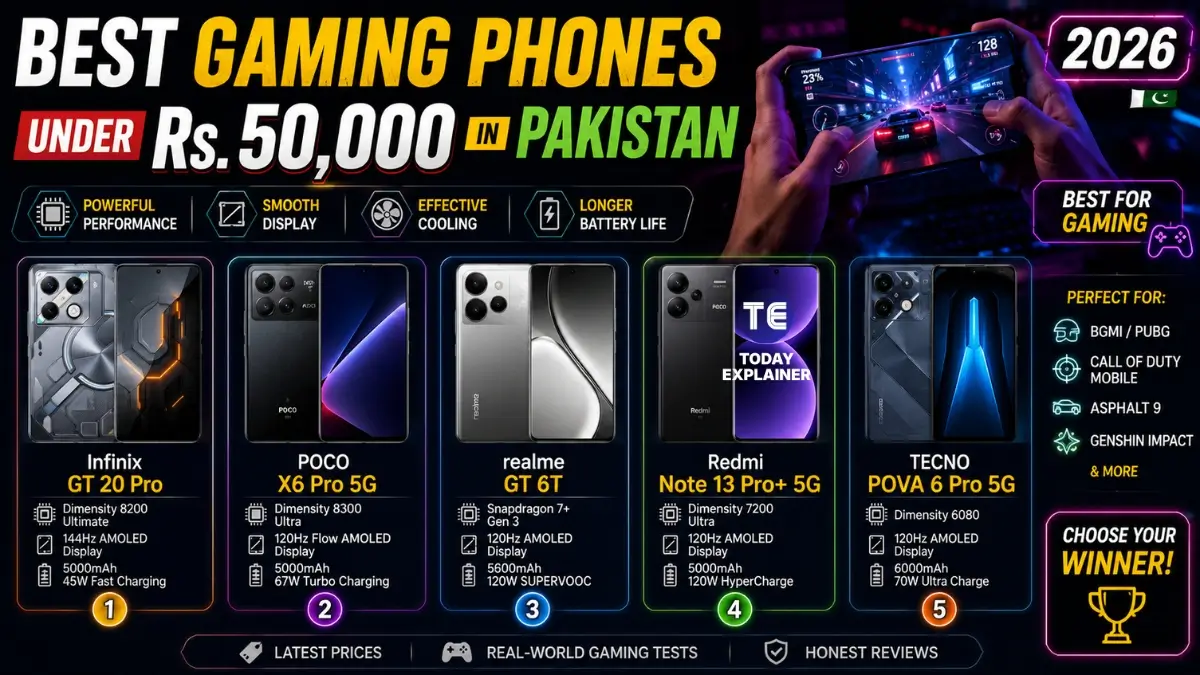
Finding a phone that actually handles PUBG Mobile, Free Fire, or Call of Duty Mobile without lag, overheating, or a dying battery — while staying under Rs. 50,000 — is harder than it should be. Spec sheets are confusing, grey-market prices are inflated, and “gaming phone” branding doesn’t always match real performance. We researched official specifications, current Pakistani retail prices, and verified user feedback to build this guide.
Mobile gaming is one of the most common smartphone uses in Pakistan today, and the Rs. 40,000–50,000 bracket has become one of the most competitive price segments in the market, with Tecno, Infinix, Xiaomi, and Samsung all releasing models aimed squarely at this budget. This guide covers what actually matters for gaming performance at this price, a full side-by-side comparison of five current options, and honest breakdowns of where each phone shines or falls short.
Quick Answer: For most Pakistani gamers on a budget near Rs. 50,000, the Tecno Pova 7 is the strongest all-round pick thanks to its 144Hz display, large battery, and chipset built with gaming in mind — but the Redmi Note 14 4G is the better choice if you want to stay closer to Rs. 45,000–48,000.
Background / Context
The under-Rs. 50,000 gaming segment has shifted noticeably over the past year. Chipsets that used to be reserved for phones above Rs. 60,000 — like MediaTek’s Dimensity 7300 and Helio G200 — are now appearing in phones priced closer to Rs. 50,000. At the same time, base prices across almost every brand have crept upward compared to last year, partly due to import costs and partly due to rupee-to-dollar exchange rate pressure, so what cost Rs. 45,000 a year ago often costs Rs. 50,000–55,000 today.
This matters right now because buyers searching for “under 50,000” phones will find that several genuinely good gaming options sit right at the edge of that budget — sometimes a little under, sometimes a little over depending on the retailer and ongoing discounts. We’ve included honest current pricing for each phone below so you know exactly where each one stands.
Key Specs & Terms Explained
Before comparing phones, it helps to understand what actually affects gaming performance versus what’s just marketing language.
- Chipset (SoC): The combined processor and graphics chip. This is the single biggest factor in how well a phone runs games like PUBG Mobile or COD Mobile at higher graphics settings.
- GPU (Graphics Processing Unit): Part of the chipset responsible for rendering game visuals. A phone can have a decent CPU but a weak GPU, which shows up as choppy frame rates in graphics-heavy games.
- Refresh Rate: How many times per second the screen redraws (measured in Hz). A 120Hz or 144Hz screen makes fast-paced games and scrolling feel noticeably smoother than a standard 60Hz or 90Hz panel — but only if the game itself supports that frame rate.
- RAM (Random Access Memory): Temporary memory used to run apps and games. 8GB is now the practical minimum for smooth multitasking while gaming in this price range.
- Virtual RAM / RAM Expansion: A software feature that borrows storage space to act as extra RAM. It helps with multitasking but does not improve raw gaming performance, and can add wear to the phone’s storage over time.
- OIS (Optical Image Stabilization): A camera feature, not related to gaming, but often listed alongside gaming specs in marketing — worth knowing so you don’t confuse it with a performance feature.
- Fast Charging (Wattage): How quickly the battery recharges. Higher wattage (45W+) means shorter charging breaks between gaming sessions.
- PTA Approval: Confirmation that a phone’s IMEI is registered for use on Pakistani mobile networks. Non-PTA-approved phones eventually lose mobile network access.
| Term | Simple Definition | Why It Matters for Buyers |
|---|---|---|
| Chipset (SoC) | The phone’s processor + graphics unit | Determines whether games run smoothly or lag |
| Refresh Rate | How often the screen redraws per second | Higher Hz feels smoother in supported games |
| RAM | Temporary memory for running apps/games | More RAM means better multitasking while gaming |
| Virtual RAM | Storage borrowed to simulate extra RAM | Helps multitasking, does not boost real performance |
| Fast Charging | Charging speed in watts | Higher wattage means less downtime between sessions |
| PTA Approval | Network registration status of the IMEI | Required for long-term SIM/network use in Pakistan |
Comparison Table (All Phones Side-by-Side)
Prices last checked August 2026 and may vary by retailer, city, and ongoing promotions.
| Phone | Price (PKR) | Display | Chipset | RAM/Storage | Camera | Battery |
|---|---|---|---|---|---|---|
| Redmi Note 14 4G | ~48,499 | 6.67″ AMOLED, 120Hz | MediaTek Helio G99 Ultra | 8GB/128GB | 108MP main + 8MP + 2MP | 5,500mAh, 33W |
| Tecno Pova 7 Neo | ~39,999 | 6.78″ IPS, up to 144Hz | MediaTek Helio G-series | 8GB/128GB | 50MP main + 8MP front | 7,000mAh |
| Infinix Hot 60 Pro | ~51,999–58,999 | 6.78″ AMOLED, 144Hz | MediaTek Helio G200 | 8GB/128GB | 50MP main + 13MP front | 5,160mAh |
| Tecno Pova 7 | ~53,000–54,720 | 6.78″–6.82″, up to 144Hz | MediaTek Dimensity 7300 / Helio G100 (variant-dependent) | 8GB/128–256GB | 50–108MP main + 13–32MP front | 6,000–6,500mAh, 65–80W |
| Samsung Galaxy A17 | ~54,999–57,999 | 6.7″ Super AMOLED, 90Hz | MediaTek Helio G99 / Exynos 1330 (variant-dependent) | 6–8GB/128GB | 50MP main + 5MP + 2MP | 5,000mAh, 25W |
Buying tip on this table: if your hard ceiling is Rs. 50,000, the Redmi Note 14 4G and Tecno Pova 7 Neo are the safest picks. If you can stretch to Rs. 52,000–55,000 during a sale, the Infinix Hot 60 Pro and Tecno Pova 7 offer noticeably better gaming displays and chipsets.
Individual Breakdown
Redmi Note 14 4G — Best for staying comfortably under Rs. 50,000
- Price in Pakistan: PKR 48,499 onward for the 8GB/128GB variant (note: prices vary by retailer/city and change frequently)
- Key Specs:
- MediaTek Helio G99 Ultra (6nm) chipset
- 6.67-inch AMOLED display, 120Hz refresh rate
- 8GB RAM, 128GB storage (UFS storage, expandable in some markets)
- 5,500mAh battery with 33W wired charging
- 108MP triple rear camera, 20MP front camera
- What Stands Out: This is one of the few phones in this range with a genuine AMOLED panel at 120Hz, which makes everyday scrolling and menu navigation feel noticeably smoother than the IPS LCD screens common at this price. The Helio G99 Ultra handles PUBG Mobile and Free Fire comfortably on medium-high settings.
- Where It Falls Short: Heavier, graphically demanding titles at maximum settings will push this chipset into visible frame drops during extended sessions, and the phone can get warm after 30+ minutes of continuous gaming.
- Best For: Buyers who want the best display quality for the money and only play casual-to-mid-intensity games.
- Pros:
- AMOLED display at 120Hz is rare at this price
- Reliable, well-known Redmi build quality and software support
- Comfortably under the Rs. 50,000 mark
- Good camera versatility for a gaming-focused buy
- Cons:
- Not a true “gaming phone” chipset — struggles at max settings
- Charging speed (33W) is behind rivals with 65–80W
- Can warm up during long gaming sessions
Tecno Pova 7 Neo — Best battery life under Rs. 40,000
- Price in Pakistan: PKR ~39,999 (note: prices vary by retailer/city and change frequently)
- Key Specs:
- MediaTek Helio G-series chipset
- 6.78-inch IPS display, up to 144Hz refresh rate
- 8GB RAM, 128GB storage
- 7,000mAh battery
- 50MP main rear camera, 8MP front camera
- What Stands Out: The 7,000mAh battery is genuinely exceptional for this price bracket, easily lasting through a full day of mixed gaming and daily use without a midday charge. The 144Hz-capable IPS panel adds smoothness for games and UI navigation that support it.
- Where It Falls Short: The chipset is entry-level for gaming purposes, so demanding titles need to run on lower graphics settings, and the display is IPS LCD rather than AMOLED, so colors and contrast are noticeably flatter.
- Best For: Students and heavy daily users who prioritize battery endurance over peak gaming performance and want the most headroom under a strict Rs. 40,000 budget.
- Pros:
- Massive 7,000mAh battery
- Up to 144Hz refresh rate at this price is unusual
- Clearly the most affordable option in this list
- Large, comfortable display for gaming
- Cons:
- IPS LCD, not AMOLED — weaker contrast and colors
- Chipset limits high-settings performance in demanding titles
- Heavier due to the large battery
Infinix Hot 60 Pro — Best display for gaming near Rs. 50,000
- Price in Pakistan: PKR ~51,999–58,999 depending on retailer and ongoing discounts (note: prices vary by retailer/city and change frequently)
- Key Specs:
- MediaTek Helio G200 (6nm) chipset
- 6.78-inch AMOLED display, 144Hz refresh rate, up to ~1,600 nits brightness
- 8GB RAM, 128GB storage
- 5,160mAh battery
- 50MP main rear camera, 13MP front camera
- IP64 dust and splash resistance
- What Stands Out: The Helio G200 is one of the newer, more gaming-capable chipsets to reach this price range, and combined with the 144Hz AMOLED display, this is arguably the most complete gaming package on this list once you cross the Rs. 50,000 line. The IP64 rating is also a genuine bonus most rivals skip.
- Where It Falls Short: Pricing fluctuates quite a bit between retailers — some list it close to Rs. 52,000 while others push toward Rs. 58,000-plus, so shoppers strictly capped at Rs. 50,000 may need to hunt for a discount or consider a cheaper alternative.
- Best For: Gamers who can flex their budget slightly above Rs. 50,000 for a noticeably better screen and chipset.
- Pros:
- Genuinely modern gaming chipset for this price tier
- 144Hz AMOLED display with high peak brightness
- IP64 splash and dust resistance
- Fast display response for competitive gaming
- Cons:
- Frequently priced above Rs. 50,000 depending on retailer
- Battery capacity (5,160mAh) is smaller than some rivals
- Camera is a single main sensor, less versatile than dual/triple setups
Tecno Pova 7 — Best all-round gaming pick (slightly above 50k)
- Price in Pakistan: PKR ~53,000–54,720 for the base 8GB/128GB or 8GB/256GB variant (note: prices vary by retailer/city and change frequently)
- Key Specs:
- MediaTek Dimensity 7300 or Helio G100 depending on retail variant
- 6.78–6.82-inch display, up to 144Hz refresh rate
- 8GB RAM, 128GB or 256GB storage
- 6,000–6,500mAh battery, 65–80W fast charging (variant-dependent)
- 50–108MP main rear camera, 13–32MP front camera
- What Stands Out: Tecno markets the Pova series directly at gamers, and it shows — this is the phone on this list built around sustained gaming performance, with a large battery, fast charging to minimize downtime, and a high refresh rate display designed for competitive titles.
- Where It Falls Short: Specs vary noticeably between retail listings (different chipset and camera configurations appear under the same name), so it’s worth confirming the exact variant and chipset before buying, and it sits clearly above the Rs. 50,000 mark at most sellers.
- Best For: Buyers whose top priority is gaming performance and battery life, and who are comfortable spending slightly over Rs. 50,000.
- Pros:
- Purpose-built gaming positioning with strong battery + fast charging combo
- High refresh rate display up to 144Hz
- Large storage options (up to 256GB on some variants)
- Strong value if bought during a discount period
- Cons:
- Specs and pricing vary by listing/variant — requires careful checking
- Consistently priced above the Rs. 50,000 target for most buyers
- IPS panel on most variants, not AMOLED
Samsung Galaxy A17 — Best Samsung option under 50k (software & display over raw gaming power)
- Price in Pakistan: PKR ~54,999–57,999, with some listings as low as ~54,999 during promotions (note: prices vary by retailer/city and change frequently)
- Key Specs:
- MediaTek Helio G99 or Exynos 1330, depending on the 4G/5G variant
- 6.7-inch Super AMOLED display, 90Hz refresh rate, Gorilla Glass Victus+
- 6GB or 8GB RAM, 128GB storage (expandable via microSD)
- 5,000mAh battery, 25W wired charging
- 50MP OIS main camera + 5MP + 2MP rear, 13MP front
- What Stands Out: This is the phone to pick if brand trust, resale value, and long-term software support matter as much as gaming — Samsung’s update promise on the A-series is unusually strong for this price, and the Super AMOLED screen looks excellent for everyday use and casual gaming.
- Where It Falls Short: Samsung is explicit that the Helio G99 chipset is meant for casual gaming rather than demanding titles at high settings, the refresh rate tops out at 90Hz (not 120/144Hz like most rivals here), and 25W charging is the slowest on this list.
- Best For: Buyers who play casually but want the best all-round phone — camera, screen, resale value, and software updates — rather than a dedicated gaming machine.
- Pros:
- Best software update promise on this list (Samsung’s multi-year commitment)
- Genuine Super AMOLED display with strong outdoor visibility
- Strong resale value and brand trust in the Pakistani market
- IP54 splash resistance
- Cons:
- Weakest gaming chipset of the group for demanding titles
- 90Hz refresh rate, not 120Hz or 144Hz
- Slowest charging speed (25W) on this list
- Usually the most expensive of the five options
Why This Matters (Buyer Decision Factors)
Chipset vs. Display: what should you prioritize?
If your games run mostly on medium settings anyway, a great display (like the Hot 60 Pro’s or Redmi Note 14’s AMOLED panel) will improve your day-to-day experience more than a marginally faster chipset. If you’re chasing maximum settings and the smoothest possible frame rates in competitive titles, prioritize the chipset first — the Tecno Pova 7 and Infinix Hot 60 Pro lead here.
Battery life vs. charging speed
Some buyers value never having to think about battery all day (the Pova 7 Neo’s 7,000mAh cell is built for this). Others prefer a smaller battery that recharges fast between sessions (the Pova 7’s 65–80W charging). Think about how you actually game — long uninterrupted sessions favor big-battery phones; short bursts between classes or work favor fast charging.
Sustained performance over benchmark numbers
Many buyers compare gaming phones by looking at RAM, storage, or benchmark scores alone. In practice, how a chipset performs after 20–30 minutes of continuous gaming — once the phone has warmed up — matters more than its peak benchmark score. Phones with better cooling design and power management (generally the ones marketed specifically for gaming, like the Pova series) tend to hold their frame rate more consistently through a full match.
AMOLED vs. IPS LCD
AMOLED panels (Redmi Note 14, Infinix Hot 60 Pro, Samsung Galaxy A17) offer deeper blacks, better contrast, and usually better outdoor visibility than the IPS LCD panels used on the two Tecno Pova models. This affects visual clarity during gaming but not raw frame rate performance.

RAM and storage headroom
8GB RAM is now the practical baseline across this entire list. Storage matters more if you install multiple large games (PUBG Mobile alone can exceed 3–4GB), so 128GB is a reasonable minimum, and 256GB (available on some Pova 7 variants) gives more breathing room.
Buying Tip: Don’t rely on “Virtual RAM” or RAM expansion marketing to make a decision — it borrows from your storage and doesn’t improve actual gaming performance. Check the phone’s real, physical RAM figure instead.
What to Expect Next (Category Trends)
- Chipsets are trickling down faster than before. MediaTek’s Dimensity 7000-series and Helio G200 chips, once found only in phones above Rs. 60,000, are now appearing closer to the Rs. 50,000 mark — expect this trend to continue as newer chipsets launch through late 2026.
- Prices are likely to stay volatile rather than fall. Exchange rate pressure and import costs have pushed most manufacturers to raise base prices over the past year rather than lower them, so buyers should expect prices in this bracket to hover around current levels or edge upward rather than drop significantly.
- 144Hz displays are becoming the new standard, not a premium feature. Multiple phones on this list already ship with 144Hz-capable panels near Rs. 50,000, and this refresh rate is likely to become the default expectation at this price point going into 2027.
Common Misconceptions
Myth: A higher RAM number always means better gaming performance. Reality: RAM affects multitasking and how many apps stay open in the background, but the chipset (CPU + GPU) is what actually determines how smoothly a game runs. A phone with 8GB RAM and a strong chipset will usually outperform one with 12GB RAM and a weak chipset.
Myth: Grey market (non-PTA) phones are just as safe to buy as PTA-approved ones. Reality: Grey market phones often cost less upfront, but non-PTA-approved IMEIs eventually lose access to Pakistani mobile networks, meaning the phone can only be used on Wi-Fi calling. Always confirm PTA approval status before buying.
Myth: A 144Hz screen always feels twice as smooth as a 90Hz one. Reality: The benefit only applies if the specific game you’re playing supports that refresh rate, and if the chipset can actually sustain that frame rate during gameplay. Many games cap out well below 144fps regardless of the screen’s capability.
Myth: More megapixels on the camera means a genuinely better camera. Reality: Megapixel count is one factor among many — sensor size, software processing, and stabilization (like OIS) usually matter more for real-world photo quality than the raw megapixel figure.
Myth: “Gaming phone” branding guarantees the best gaming performance in its price range. Reality: Marketing labels help with positioning, but the actual chipset, cooling design, and sustained performance are what matter — some non-“gaming”-branded phones on this list outperform branded ones in real use.
Myth: Extended/virtual RAM is the same as having more physical RAM. Reality: Virtual RAM borrows unused storage space to behave like extra memory, which helps keep more apps open but does not add real processing power or improve frame rates in games.
Myth: The most expensive phone under Rs. 50,000 is automatically the best gaming choice. Reality: As this comparison shows, price doesn’t map directly to gaming performance — a Rs. 48,500 phone (Redmi Note 14 4G) can offer a better display than a pricier option, while a cheaper phone (Pova 7 Neo) can outlast all of them on battery.

Recent Developments (Last 6–12 Months)
- Mid-2026: MediaTek’s Helio G200 chipset began appearing in phones like the Infinix Hot 60 Pro, bringing gaming-focused chip improvements closer to the Rs. 50,000 price band than in previous years.
- 2026: Samsung’s Galaxy A17 launched with an unusually strong software update promise (multiple years of OS upgrades) for a sub-Rs. 60,000 device, shifting the value proposition in this segment toward long-term support rather than pure gaming power.
- 2026: Several Infinix and Tecno models moved between the Rs. 40,000–60,000 range multiple times within months due to retailer discounts and shifting import costs, making it worth comparing prices across two or three sellers before buying.
- 2026: PTA import tax rates on registering non-approved devices have continued to apply, reinforcing the importance of buying officially PTA-approved units through authorized local dealers to avoid registration costs after purchase.
- 2026: Battery capacities in this segment have trended upward, with 6,000mAh–7,000mAh batteries (Tecno Pova series) becoming more common at prices previously dominated by 5,000mAh cells.
Real Buyer Scenarios
The following are illustrative buyer profiles, not real customer testimonials.
A university student on a tight, fixed budget who mainly plays Free Fire and Ludo between classes and needs the phone to last a full day without a charger nearby would be well served by the Tecno Pova 7 Neo — its 7,000mAh battery removes the daily charging worry, and its price leaves the most room in a student budget.
A competitive PUBG Mobile player who games for hours in the evening and wants the smoothest possible screen and chipset combination without going far over budget would likely prefer the Infinix Hot 60 Pro or Tecno Pova 7, both of which prioritize sustained gaming performance and high refresh rate displays over other features.
A buyer replacing an older phone who wants one device that handles gaming, photos, and years of software updates without needing to think about brand reliability would likely lean toward the Samsung Galaxy A17, accepting a less powerful chipset in exchange for display quality, resale value, and Samsung’s long update commitment.
Buying Tips for This Price Range
- Always confirm PTA approval before paying — ask the seller directly and verify the IMEI status if buying second-hand or from an unfamiliar shop.
- Compare prices across at least two or three retailers (official brand stores, PriceOye, WhatMobile listings) since prices for the same phone can vary by several thousand rupees.
- Check which exact chipset variant you’re buying, especially for phones like the Tecno Pova 7 where different retail listings show different chipsets under the same model name.
- Prioritize official warranty over a slightly lower grey-market price — warranty coverage matters more at this price point, where repair costs can be a significant fraction of the phone’s value.
- Don’t overpay for RAM expansion or “virtual RAM” marketing — check the actual physical RAM figure, which is what affects real performance.
- Buy during sale periods (major online marketplace sales, Eid promotions) since several phones on this list have shown meaningful price drops from their base price during such windows.
- Avoid unofficial import units without local warranty support, since repairs and parts availability are far more limited than for officially distributed phones.
Conclusion and Final Verdict
- Best overall for gaming performance: Tecno Pova 7 — built specifically with gaming in mind, with the strongest combination of chipset, refresh rate, and charging speed, if you can stretch slightly past Rs. 50,000.
- Best if you must stay under Rs. 50,000: Redmi Note 14 4G — the best display quality and most trusted brand reliability while staying comfortably within budget.
- Best battery life: Tecno Pova 7 Neo — the 7,000mAh battery is unmatched on this list, at the lowest price of the five.
- Best display for gaming: Infinix Hot 60 Pro — 144Hz AMOLED with high brightness, if you can catch it near its lower price point.
- Best for software support and resale value: Samsung Galaxy A17 — trades gaming power for Samsung’s brand trust and long update promise.
The Bottom Line: There is no single “best” phone here — there’s a best phone for your specific budget ceiling and gaming habits. If Rs. 50,000 is a hard limit, the Redmi Note 14 4G is the safest, best-balanced choice. If you can flex a little higher during a sale, the Tecno Pova 7 and Infinix Hot 60 Pro deliver noticeably better sustained gaming performance, and neither compromise is unreasonable — it genuinely comes down to whether display quality, battery life, or raw gaming performance matters most to you.
FAQs
Q: What is the single best gaming phone under Rs. 50,000 in Pakistan right now? A: Based on current pricing, the Redmi Note 14 4G is the best pick that stays reliably under Rs. 50,000, while the Tecno Pova 7 offers stronger gaming performance if your budget can flex slightly higher.

Q: Is 8GB RAM enough for gaming under Rs. 50,000? A: Yes — 8GB RAM is the practical standard across nearly every phone in this price range and is sufficient for games like PUBG Mobile, Free Fire, and COD Mobile.
Q: Do I need a 5G phone if I mainly play games on Wi-Fi? A: No — if you play mostly on Wi-Fi, a 4G phone with a strong chipset (like the Redmi Note 14 4G) will perform just as well for gaming as a 5G equivalent.
Q: Which chipset is best for gaming in this price range? A: The MediaTek Dimensity 7300 and Helio G200 (found in the Tecno Pova 7 and Infinix Hot 60 Pro) are currently the strongest gaming-oriented chipsets available near Rs. 50,000 in Pakistan.

Q: Is the Samsung Galaxy A17 good for gaming? A: It’s capable of casual gaming but its Helio G99/Exynos 1330 chipset and 90Hz display are not built for demanding titles at high settings — it’s a better pick for buyers who value display quality, camera, and software support over pure gaming performance.
Q: Why do prices for the same phone vary between websites? A: Retailers set their own margins and run different promotions, so prices for identical phones can differ by several thousand rupees — always compare two or three sources before buying.
Q: Is it safe to buy a non-PTA-approved phone if it’s cheaper? A: It’s risky — non-PTA phones eventually lose mobile network access on Pakistani SIMs, so any upfront savings can be offset by PTA registration taxes or a phone that can’t make calls or use mobile data long-term.

Q: What’s the difference between AMOLED and IPS LCD for gaming? A: AMOLED offers deeper blacks and better contrast, which can make games look sharper, but it doesn’t change frame rate or performance — that comes entirely from the chipset.
Q: Does a 144Hz screen always mean smoother gameplay? A: Only if both the specific game and the chipset can sustain that frame rate — many popular mobile games cap well below 144fps regardless of the screen’s maximum refresh rate.
Q: Which phone on this list has the best camera? A: The Redmi Note 14 4G’s 108MP triple camera setup offers the most versatility, though the Samsung Galaxy A17’s OIS-stabilized 50MP main sensor often produces steadier results in lower light.
Q: Should I buy now or wait for a price drop? A: Prices in this segment have trended flat-to-upward over the past year rather than downward, so waiting doesn’t guarantee savings — watching for sale periods on your chosen model is usually more effective than waiting indefinitely.
Q: Is virtual/extended RAM worth paying extra for? A: No — it borrows storage space to simulate extra memory and helps with multitasking, but it does not improve actual gaming performance, so it shouldn’t be a deciding factor.
Q: Can I play PUBG Mobile at max graphics settings on any of these phones? A: The Tecno Pova 7 and Infinix Hot 60 Pro come closest to handling higher settings smoothly; the others are better suited to medium settings for consistently smooth frame rates.

Q: Which of these phones has the fastest charging? A: The Tecno Pova 7 leads with charging speeds up to 65–80W depending on the variant, significantly faster than the Samsung Galaxy A17’s 25W.
Q: Are these prices likely to be accurate when I check today? A: Treat them as a starting reference — mobile prices in Pakistan change frequently, so always verify the current price with the retailer before purchasing.
Where to Verify Prices & Specs
- GSMArena — for detailed, brand-independent technical specifications
- Official brand websites (Samsung Pakistan, Xiaomi/Redmi, Infinix, Tecno) — for official launch pricing and warranty terms
- PriceOye — for current Pakistani retail pricing across multiple sellers
- WhatMobile — for daily-updated local market prices
Discussion
- Which matters more to you when gaming on a budget: raw chipset performance, battery life, or display quality — and why?
- Have you noticed prices for any of these models shifting since this guide was last updated? Share what you’re seeing at your local shop.
- If your budget is flexible by a few thousand rupees either way, which of these five would you choose, and what would you give up to get it?