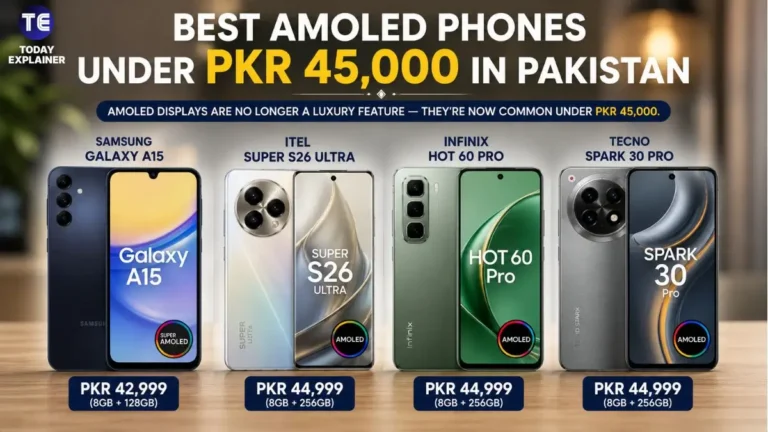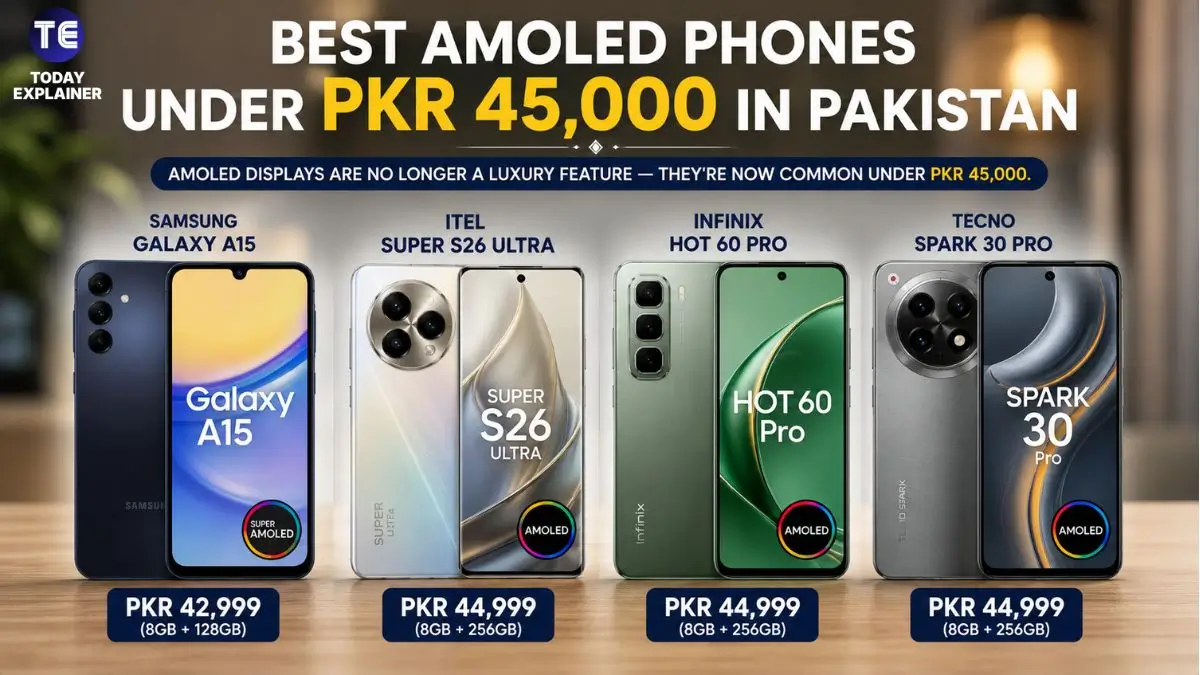
AMOLED displays are no longer a luxury feature — they're now common under PKR 45,000.
Table of Contents
- Introduction — Why This Matters
- Background / Context
- Key Specs & Terms Explained
- Comparison Table (All Phones Side-by-Side)
- Individual Breakdown
- Why This Matters (Buyer Decision Factors)
- What to Expect Next (Category Trends)
- Common Misconceptions
- Recent Developments
- Real Buyer Scenarios
- Buying Tips for This Price Range
- Conclusion and Final Verdict
- FAQs
- About the Author
- Where to Verify Prices & Specs
- Discussion
Introduction — Why This Matters
Shopping for a phone under PKR 45,000 in Pakistan used to mean settling for a dull, washed-out LCD screen. That’s changed fast. AMOLED panels — once reserved for phones twice this price — have moved down into this exact bracket, and picking the wrong one still means overpaying for a mediocre chipset or a camera that struggles indoors.
We researched official specifications, current Pakistani retail prices, and verified user feedback across PriceOye, WhatMobile, and official brand stores to build this guide. AMOLED displays are increasingly described as standard rather than premium in the sub-50,000 segment in Pakistan, with brands like Samsung, itel, Infinix, and Tecno all now offering AMOLED panels well under the 45,000 mark.
This article walks through what actually makes an AMOLED screen worth paying for, compares four of the strongest options currently available under PKR 45,000, and breaks down where each one falls short — because every phone at this price makes at least one compromise. We’ll also cover buying tips specific to Pakistan’s market, from PTA approval to grey-market risks.
Quick Answer: If you want the most balanced all-rounder, the Samsung Galaxy A15 is our top pick under PKR 45,000 — it pairs a genuine Super AMOLED display with Samsung’s long software-support track record. If you want the best screen for the money, the itel Super S26 Ultra offers a 144Hz curved AMOLED panel that’s rare at this price.
Background / Context
The sub-45,000 category in Pakistan has shifted noticeably over the past year. Chinese and Korean brands have been racing to push 120Hz-plus AMOLED panels further down their lineups, partly because panel manufacturing costs have dropped and partly because AMOLED has become a key marketing differentiator against Chinese-market-only brands entering Pakistan.
At the same time, PKR pricing on phones in Pakistan continues to move with import duties, currency fluctuation, and PTA tax changes, so a phone that was PKR 40,000 three months ago can easily be PKR 46,000 today — or the reverse. This is especially true for phones near the 45,000 line, where a single retailer promotion or a fresh PTA tax notification can push a phone in or out of the bracket entirely. We’ve flagged this volatility wherever it applies below.
Key Specs & Terms Explained
Before comparing phones, it helps to understand what you’re actually paying for.
- AMOLED / Super AMOLED: A display technology where each pixel produces its own light, giving true blacks, higher contrast, and better outdoor visibility than standard LCD panels. “Super AMOLED” is Samsung’s branded version of the same underlying tech.
- Refresh Rate (Hz): How many times per second the screen redraws. 90Hz and 120Hz feel noticeably smoother when scrolling than the standard 60Hz; 144Hz is mostly a marketing number at this price since few games can push that frame rate on budget chipsets.
- Chipset: The phone’s processor. It determines how fast apps open, how well the phone handles multitasking, and how hot it runs under load. MediaTek Helio and Dimensity chips, and Unisoc chips, dominate this price bracket.
- RAM/Storage: RAM affects how many apps stay open in the background without reloading; storage determines how many apps, photos, and videos you can keep. 8GB RAM and 128GB storage is now the practical minimum worth buying.
- OIS (Optical Image Stabilization): Rare at this price, this hardware feature reduces blur in photos and video. Most phones under 45,000 skip it entirely and rely on software stabilization instead.
- Fast Charging (W): Higher wattage means a shorter time from empty to full. Anything from 18W to 45W is common in this bracket; the real-world difference matters most for people who charge quickly between classes or shifts.
- PTA Approval: Every phone used in Pakistan on a local SIM must be registered with the Pakistan Telecommunication Authority. Unapproved phones lose network access after a grace period, regardless of how good the hardware is.
| Term | Simple Definition | Why It Matters for Buyers |
|---|---|---|
| AMOLED | Self-lit display panel with true blacks | Better contrast, saves battery on dark themes |
| Refresh Rate | Screen redraws per second | Higher feels smoother, but drains battery faster |
| Chipset | The phone’s processor | Determines speed, gaming ability, and heat |
| RAM/Storage | Working memory and file space | Affects multitasking and how long the phone stays usable |
| OIS | Hardware camera stabilization | Sharper photos/video in low light and while moving |
| Fast Charging | Charging speed in watts | Less time tethered to a charger |
| PTA Approval | Official device registration | Required for the phone to keep working on local SIMs |
Comparison Table (All Phones Side-by-Side)
| Phone | Price (PKR) | Display | Chipset | RAM/Storage | Camera | Battery |
|---|---|---|---|---|---|---|
| Samsung Galaxy A15 | ~44,999 | 6.5″ Super AMOLED, 90Hz | MediaTek Dimensity 6100+ | 6GB/128GB (8GB/256GB available) | 50MP + 5MP + 2MP rear, 13MP front | 5,000mAh |
| itel Super S26 Ultra | ~44,299–45,500 | 6.78″ curved AMOLED, 144Hz | Unisoc T7300 | 8GB/128GB (256GB available) | 50MP + 2MP rear, 32MP front | 6,000mAh, 18W |
| Infinix Hot 60 Pro | ~43,500–45,999 (price has been volatile) | 6.78″ AMOLED, 144Hz | MediaTek Helio G200 | 8GB/128GB | 50MP rear, 13MP front | 5,160mAh, 45W |
| Tecno Spark 30 Pro | ~36,199–39,999 | 6.78″ AMOLED, 90Hz | Octa-core gaming chipset | 8GB/128GB | 108MP rear, 13MP front | ~5,000mAh |
Prices last checked August 2026 and may vary by retailer.
Individual Breakdown
Samsung Galaxy A15 — The Dependable All-Rounder
- Price in Pakistan: PKR 44,999 (lowest listed price; official warranty listings run higher, around PKR 52,999–59,999 depending on variant and retailer)
- Key Specs:
- 6.5-inch Super AMOLED display, 90Hz refresh rate
- MediaTek Dimensity 6100+ chipset (some variants use Helio P35)
- 6GB/128GB, with 8GB/256GB also available
- 50MP main + 5MP ultrawide + 2MP macro rear; 13MP front
- 5,000mAh battery
- What Stands Out: Samsung’s software update commitment is the real selling point here — the Galaxy A-series typically gets years of security patches longer than most Chinese rivals in this bracket, and the Super AMOLED panel is genuinely one of the punchiest screens under 45,000.
- Where It Falls Short: The chipset is only adequate for everyday use; heavier games will need reduced graphics settings, and the base 6GB RAM variant can feel tight with heavy multitasking.
- Best For: Buyers who prioritize long-term software support and a Samsung ecosystem over raw gaming performance.
- Pros:
- Genuine Super AMOLED panel with strong outdoor visibility
- Long track record of Android security updates
- Widely available with easy warranty claims through Samsung’s official network
- Solid daylight camera performance
- Cons:
- Only 90Hz refresh rate versus 120–144Hz rivals
- Mid-tier chipset limits gaming
- Lowest-price variant has less RAM than some competitors
itel Super S26 Ultra — Best Screen for the Money
- Price in Pakistan: PKR ~44,299–45,500 (varies by retailer and storage variant; some listings show it just over or under the 45,000 line)
- Key Specs:
- 6.78-inch curved AMOLED display, 144Hz refresh rate, up to 4,500 nits peak brightness
- Unisoc T7300 chipset (6nm)
- 8GB RAM (expandable), 128GB/256GB storage
- 50MP + 2MP rear, 32MP front
- 6,000mAh battery, 18W charging
- Corning Gorilla Glass 7i, IP64/IP65 splash resistance depending on variant
- What Stands Out: A curved 144Hz AMOLED panel with this much peak brightness is unusual at this price — it’s arguably the best-looking screen you can get for under PKR 45,000 in Pakistan right now, and the 6,000mAh battery genuinely lasts a full day of heavy use.
- Where It Falls Short: The Unisoc T7300 is a capable everyday chipset but isn’t built for demanding games, and 18W charging is slow for a battery this large — expect a longer wait to top up.
- Best For: Buyers who care most about screen quality and battery life over raw performance.
- Pros:
- Best display quality in this comparison
- Large 6,000mAh battery
- Ample 8GB RAM as standard
- IP64/IP65-rated build for splash resistance
- Cons:
- Slow 18W charging for the battery size
- Unisoc chipset lags behind MediaTek in gaming benchmarks
- itel’s after-sales network is smaller than Samsung’s or Infinix’s in some cities
Infinix Hot 60 Pro — Best for Gaming and Battery Life
- Price in Pakistan: PKR ~43,500–45,999 for the base 8GB/128GB variant (note: pricing on this model has fluctuated significantly across retailers and time periods — some listings show it well above 45,000, so confirm the current price before buying)
- Key Specs:
- 6.78-inch AMOLED display, 144Hz refresh rate, ~1600 nits HBM brightness
- MediaTek Helio G200 (6nm) chipset
- 8GB RAM (plus extended RAM), 128GB storage
- 50MP rear, 13MP front
- 5,160mAh battery, 45W fast charging
- Gorilla Glass 7i, IP64 splash resistance
- What Stands Out: The Helio G200 handles mid-range gaming noticeably better than the Unisoc and older MediaTek chips typically found at this price, and 45W charging is fast for this bracket — a real convenience upgrade over rivals stuck at 18W.
- Where It Falls Short: This is the most price-volatile phone in our comparison; several retailers have listed it anywhere from the low 40,000s to well above 45,000 within the same few months, so it may not consistently qualify as an “under 45,000” phone depending on when and where you buy.
- Best For: Buyers who want the best gaming performance and fastest charging in this group and are willing to shop around for the best current price.
- Pros:
- Strongest gaming chipset in this lineup
- Fast 45W charging
- Bright, smooth 144Hz AMOLED display
- IP64 splash resistance
- Cons:
- Price has been inconsistent across retailers and time — confirm before purchase
- Single rear camera sensor limits versatility
- Plastic back/frame feels less premium than the display suggests
Tecno Spark 30 Pro — Best Budget Pick Under 40,000
- Price in Pakistan: PKR ~36,199–39,999, giving the most headroom below the 45,000 ceiling
- Key Specs:
- 6.78-inch AMOLED display, 90Hz refresh rate
- Octa-core gaming-tuned chipset
- 8GB RAM, 128GB storage
- 108MP rear main camera, 13MP front
- Roughly 5,000mAh battery
- What Stands Out: This is the cheapest way into a large AMOLED display with 8GB RAM in our comparison, and the 108MP camera resolution outclasses every other phone here on paper, giving more detail to crop into for social posts.
- Where It Falls Short: The 90Hz refresh rate is the lowest of the AMOLED phones compared here, and megapixel count doesn’t always translate to better real-world photos — low-light shots are noticeably weaker than the Galaxy A15’s.
- Best For: Budget-conscious buyers who want AMOLED and don’t need the fastest refresh rate or gaming performance.
- Pros:
- Lowest price of the four, with real headroom under 45,000
- Large 6.78-inch AMOLED display
- 8GB RAM as standard
- High-resolution 108MP main camera
- Cons:
- 90Hz refresh rate versus 144Hz rivals
- Camera megapixels don’t fully compensate for smaller sensor size in low light
- Tecno’s software update policy is shorter than Samsung’s
Why This Matters (Buyer Decision Factors)
Display Quality vs. Refresh Rate
Not all AMOLED panels are equal. A 90Hz Super AMOLED screen with accurate colors, like the Galaxy A15’s, can look better in daily use than a 144Hz panel with oversaturated colors and lower peak brightness. Refresh rate numbers make for easy marketing, but panel calibration matters just as much for everyday comfort.
Chipset vs. Camera Megapixels
A 108MP camera sounds impressive, but sensor size, software processing, and chipset image-signal-processing power usually matter more than raw megapixel count. If gaming or multitasking speed matters more to you than photo detail, prioritize the chipset over the camera spec sheet.
Battery Capacity vs. Charging Speed
A bigger battery is only half the story — how fast it recharges matters just as much for daily convenience. The itel Super S26 Ultra has the largest battery here but the slowest charging; the Infinix Hot 60 Pro has a smaller battery but recharges in a fraction of the time.
Software Support Length
Phones in this price range rarely get more than two years of major Android updates, with Samsung being the clear exception. If you plan to keep your phone for three-plus years, this should weigh heavily in your decision even over screen or camera specs.
Buying Tip: Don’t buy based on refresh rate or megapixel numbers alone. Ask to see the phone in person under bright light and check how it handles a demanding app before deciding — spec sheets don’t capture real-world screen brightness or thermal throttling.
What to Expect Next (Category Trends)
- 120Hz+ AMOLED is becoming the norm, not the exception, in this bracket. Expect most new launches from Infinix, itel, and Tecno in late 2026 to ship with at least 120Hz AMOLED panels as standard.
- 5G is creeping into this price segment, though most current AMOLED options under 45,000 remain 4G-only; buyers expecting 5G at this exact price point may need to wait for the next product cycle or stretch their budget slightly.
- Prices in this bracket will likely stay volatile through the rest of 2026 due to ongoing currency fluctuation and periodic PTA tax adjustments — the same phone can shift a few thousand rupees in either direction within weeks.
Common Misconceptions
Myth: A higher refresh rate always means a better display. Reality: Refresh rate affects smoothness, but color accuracy, peak brightness, and panel calibration matter just as much for how good a screen actually looks and feels to use.
Myth: More RAM always means better performance. Reality: RAM only helps if the chipset itself is fast enough to use it well. An 8GB RAM phone with a weak chipset can still feel sluggish under heavy load.
Myth: Higher megapixel cameras always take better photos. Reality: Sensor size, software processing, and lens quality usually matter more than raw megapixel count, especially in low light.
Myth: Grey-market phones are just as safe as PTA-approved ones. Reality: Unapproved phones can lose access to local mobile networks after a grace period, regardless of how good the hardware specs are — always confirm PTA status before buying.
Myth: AMOLED phones always drain the battery faster than LCD phones. Reality: AMOLED panels actually use less power than LCD when displaying dark content, since black pixels are fully switched off; battery drain depends more on refresh rate and screen brightness settings.
Myth: A phone with a bigger battery in mAh will always last longer per day. Reality: Battery life depends on chipset efficiency and display power draw as much as raw capacity — a well-optimized 5,000mAh phone can outlast a poorly optimized 6,000mAh one.
Myth: All phones from big-name brands come with the same warranty terms in Pakistan. Reality: Warranty length and service network quality vary significantly even within the same brand depending on whether the unit was bought through an authorized dealer or a grey-market reseller.
Recent Developments (Last 6-12 Months)
- Samsung has continued discounting the Galaxy A15 aggressively on PriceOye, with its lowest listed price dropping to around PKR 44,999 as of mid-2026, down from its original higher launch pricing.
- itel expanded the Super S26 Ultra’s availability with additional storage variants (128GB and 256GB) and multiple color options through 2026.
- Infinix’s Hot 60 Pro pricing has shown notable inconsistency across retailers throughout 2026, ranging from the low 40,000s at some points to well above 60,000 at others — a reminder to always check current listings rather than relying on older price references.
- Tecno has continued pushing AMOLED panels further down its Spark lineup, positioning the Spark 30 Pro as one of the most affordable large-AMOLED options in the market.
- PTA tax rates on imported and locally assembled phones have continued to shift through 2026, which buyers should factor into any grey-market purchase decision.
Real Buyer Scenarios
A university student needing a reliable phone for online classes and light gaming: A student splitting time between Zoom lectures, WhatsApp groups, and the occasional round of a light mobile game would likely be best served by the Tecno Spark 30 Pro — it keeps the most budget headroom while still delivering a large AMOLED screen and 8GB RAM for smooth multitasking between apps.
A working professional who wants a phone that stays usable for 3+ years: Someone planning to keep their phone for the long haul should lean toward the Samsung Galaxy A15, since Samsung’s update policy typically outlasts its Chinese-brand competitors in this price range, even if it means giving up some refresh-rate smoothness.
A content-focused user who prioritizes screen and battery over performance: A buyer who spends most of their screen time watching videos or scrolling social media, and wants the phone to comfortably last a full day, would get the most value from the itel Super S26 Ultra, thanks to its standout 144Hz curved AMOLED panel and large 6,000mAh battery.
Buying Tips for This Price Range
- Always verify PTA approval before paying — check the phone’s IMEI through PTA’s official DIRBS portal, especially for grey-market or resale listings.
- Buy from authorized dealers or verified online stores like official brand outlets, PriceOye, or Daraz Mall listings rather than unverified resellers, to protect your warranty.
- Compare prices across at least two platforms (e.g., PriceOye and WhatMobile) before buying, since listed prices for the same phone can differ by several thousand rupees.
- Don’t assume the box price is the final price — city-specific taxes, retailer markups, and ongoing promotions can shift the actual amount you pay.
- Ask about warranty terms explicitly, since “1 year warranty” can mean different things depending on whether it’s brand warranty, shop warranty, or no warranty at all in grey-market listings.
- Check the exact model number, not just the marketing name, since sub-variants of the same phone name can have different RAM, storage, or even display types.
- Avoid chasing the newest launch immediately — prices on freshly launched phones in this segment often drop within the first few months as competition responds.
Conclusion and Final Verdict
- Best Overall: Samsung Galaxy A15 — for its balance of a genuine Super AMOLED display and Samsung’s software support advantage
- Best Display: itel Super S26 Ultra — for its 144Hz curved AMOLED panel and standout brightness
- Best Gaming/Charging: Infinix Hot 60 Pro — for its stronger chipset and fast 45W charging, if you can catch it at a price under 45,000
- Best Value/Budget: Tecno Spark 30 Pro — for the most headroom below the price ceiling while still getting a large AMOLED screen
The Bottom Line: There’s no single “best” phone under PKR 45,000 with AMOLED in Pakistan — there’s a best phone for what you actually use your phone for. If long-term reliability matters most, pick the Galaxy A15. If the screen itself is the priority, the itel Super S26 Ultra will impress you every time you unlock it. Just be aware that pricing in this bracket moves often, so treat every number in this guide as a starting point for your own price check, not a final figure.
FAQs
Q: What is the best phone under 45,000 in Pakistan with an AMOLED display? A: Based on current pricing and specs, the Samsung Galaxy A15 and itel Super S26 Ultra are the strongest overall picks, depending on whether you prioritize software support or screen quality.
Q: Is AMOLED better than LCD for a budget phone? A: Yes, in most cases — AMOLED offers deeper blacks, better contrast, and typically better outdoor visibility, though panel quality still varies between models.
Q: Does a higher refresh rate always make the display better? A: Not necessarily. Refresh rate affects scrolling smoothness, but brightness and color calibration matter just as much for overall display quality.
Q: Are these phones PTA approved? A: Phones sold through official Pakistani retailers and authorized dealers are generally PTA approved, but you should always verify the specific unit’s IMEI through PTA’s DIRBS portal before buying.
Q: Why do prices for the same phone vary so much between websites? A: Retailers set their own margins and run different promotions, and prices also shift with currency fluctuation and PTA tax changes, so it’s normal to see a few thousand rupees of variation.
Q: Is 8GB RAM enough for a phone under 45,000? A: Yes, 8GB RAM is now a practical baseline for smooth multitasking in this price range, and most of the phones in this comparison offer it.
Q: Which phone in this list has the best battery life? A: The itel Super S26 Ultra has the largest battery capacity at 6,000mAh, though its slower 18W charging means longer recharge times.
Q: Which phone is best for gaming under 45,000? A: The Infinix Hot 60 Pro’s MediaTek Helio G200 chipset handles gaming better than the other options compared here, though its price has fluctuated above and below the 45,000 mark.
Q: Do any of these phones support 5G? A: No — all four phones compared here are 4G-only. 5G AMOLED phones typically start above this price bracket in Pakistan as of mid-2026.
Q: Is it safe to buy a phone without official warranty to save money? A: It carries more risk. Non-warranty or grey-market units can lack after-sales support and sometimes have unclear PTA status, so the savings should be weighed against that risk.
Q: How often should I expect software updates on a budget phone? A: Most budget brands offer one to two years of meaningful updates, with Samsung generally offering a longer commitment than Chinese competitors at this price.
Q: Should I buy online or from a local mobile market? A: Both can work if you verify the seller. Online platforms like PriceOye and Daraz Mall typically offer clearer warranty terms, while local markets let you inspect the unit in person before buying.
Q: What does IP64 or IP65 rating mean on these phones? A: It indicates a level of dust and splash resistance — IP64 protects against dust ingress and water splashes, while IP65 offers slightly stronger water resistance, though neither means the phone is fully waterproof.
Q: Can I trust the megapixel count alone to judge camera quality? A: Not entirely. Megapixels are only one factor — sensor size, software processing, and lens quality all affect real-world photo results.
Q: Will prices in this bracket drop further later in 2026? A: It’s possible, given the trend of AMOLED panels moving further down the price ladder, but currency and tax factors make this difficult to predict with certainty.
About the Author
Written by the Mobile Desk at TODAY Explainer. Our team researches official specifications, tracks retail prices across major Pakistani marketplaces, and compares real-world usage patterns to build guides that help you buy with confidence.
We do not accept payment from phone brands for placement or ranking in our guides.
This guide is based on official manufacturer specifications and retail prices verified as of August 2026.
Where to Verify Prices & Specs
- GSMArena — for detailed, brand-neutral technical specifications
- Official brand websites (Samsung Pakistan, Infinix, Tecno, itel) — for launch specs and official warranty terms
- PriceOye — for current Pakistani retail pricing across multiple sellers
- WhatMobile — for daily-updated local price tracking and comparisons
Discussion
If your budget sits right around PKR 45,000, would you rather stretch a little further for better performance, or stay under the line and accept some compromises? Which matters more to you day-to-day: a smoother, higher-refresh-rate screen, or a battery that comfortably lasts a full day without a midday top-up? And if you’ve bought any of these phones recently, has your real-world experience with the screen or battery matched what the spec sheet promised?
About the Author