Table of Contents
- Introduction — Why This Matters
- Background / Context
- Key Specs & Terms Explained
- Full Specifications (Comparison Table)
- Poco X8 Power — Detailed Breakdown
- Poco X8 Power vs Poco X8
- Why This Matters (Buyer Decision Factors)
- What to Expect Next
- Common Misconceptions
- Recent Developments
- Real Buyer Scenarios
- Buying Tips for This Price Range
- Should You Buy It? Conclusion and Final Verdict
- FAQs
- Where to Verify Prices & Specs
- Discussion
Introduction — Why This Matters
Buying a mid-range phone in India usually means picking one thing to sacrifice — either the battery dies by dinner, the charging is painfully slow, or the phone can’t survive a splash of water. Poco’s answer to that problem just landed. We researched official Poco and Xiaomi specification sheets, verified Indian retail pricing, and cross-checked launch-event coverage to build this guide.
The headline number here is hard to ignore: a 10,000mAh battery, the largest Poco has ever put in a phone sold in India. That single spec is the reason this device is worth a closer look, even before you get into the display, chipset, or camera.
This guide covers the confirmed India price, the full specification sheet, how the X8 Power stacks up against its own sibling (the standard Poco X8, launched the same day), and — most importantly — who should actually spend their money on it.

Quick Answer: The Poco X8 Power is priced at ₹35,999 in India (effectively ₹32,999 with launch offers), and it’s the right pick if all-day battery life and rugged durability matter more to you than having the absolute best camera in this price bracket.
Background / Context
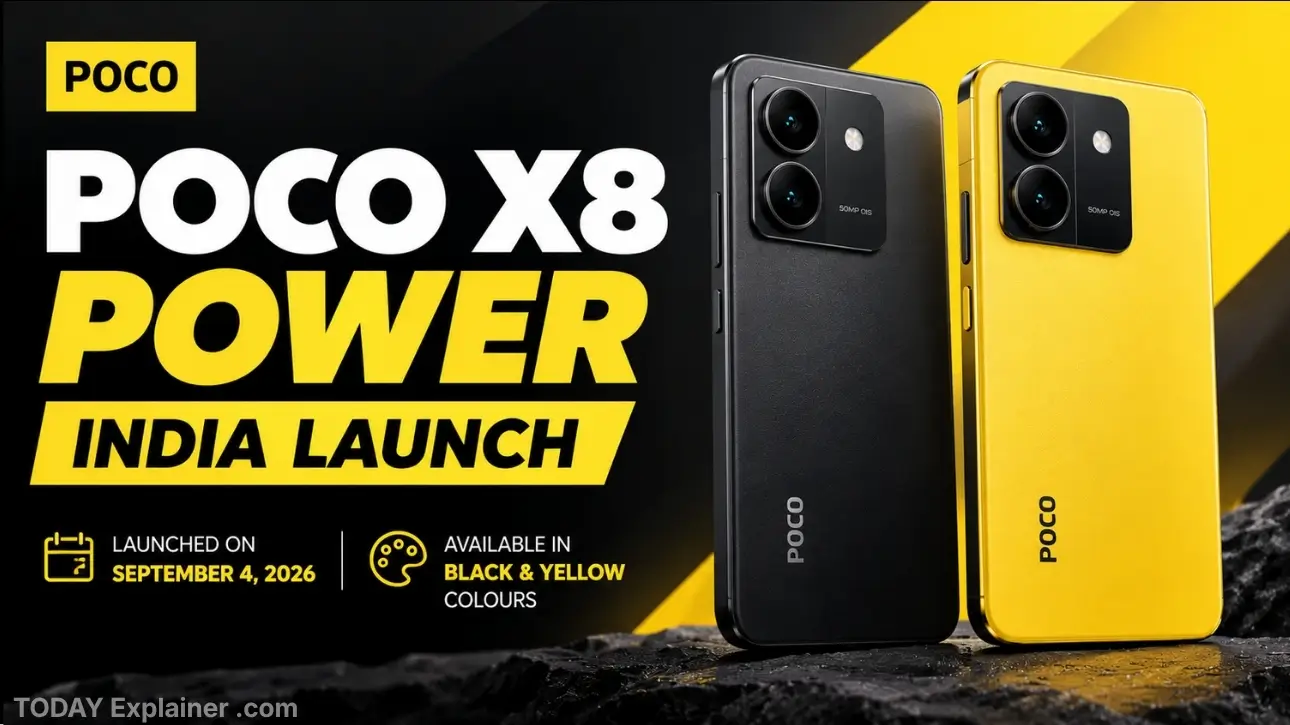
Poco’s X-series has historically sat between the budget M-series and the more premium X8 Pro / Pro Max lineup, but the brand had a gap around the ₹30,000–₹36,000 segment in India — exactly where a lot of first-time smartphone upgraders and students shop. The Poco X8 and Poco X8 Power were built to fill that gap, launching together in India on September 4–5, 2026.
Both phones lean heavily into a trend that’s picked up across the Indian mid-range market this year: silicon-carbon batteries. These cells pack more capacity into the same physical size as older lithium-ion batteries, which is how Poco fit a 10,000mAh cell into a phone that isn’t a brick. Combined with rugged IP68/IP69K ratings that used to be reserved for outdoor or rugged-series phones, the X8 Power is clearly positioned as the “buy it and stop worrying about it” option in Poco’s lineup this year.
Key Specs & Terms Explained
Before diving into the spec sheet, here’s what the jargon on the box actually means for how the phone feels to use.
| Term | Simple Definition | Why It Matters for Buyers |
|---|---|---|
| Silicon-carbon battery | A battery chemistry that mixes silicon into the anode, letting the cell hold more charge in the same physical space | It’s how Poco fit a 10,000mAh battery into a phone that isn’t unusually thick or heavy |
| 100W fast charging | The maximum wired power the phone’s charger can push into the battery | A bigger battery takes longer to charge unless the wattage scales up too — 100W keeps top-up times reasonable |
| 1.5K AMOLED | A display resolution between Full HD+ and true 2K, using AMOLED panel tech for deep blacks and rich colour | Sharper and more power-efficient than a basic Full HD+ LCD panel, without the cost of a true 2K screen |
| 120Hz refresh rate | How many times per second the screen redraws itself | Makes scrolling, animations, and casual gaming feel noticeably smoother than a standard 60Hz screen |
| IP68 / IP69 / IP69K | Ingress Protection ratings for dust and water resistance, tested under different conditions (including high-pressure, high-temperature water jets for IP69K) | Tells you how much you can trust the phone around rain, spills, or a dusty commute — not a guarantee against full submersion abuse |
| Snapdragon 6 Gen 5 | Qualcomm’s mid-range mobile chipset, the processor that handles everything from app-opening speed to gaming performance | Determines how snappy the phone feels day-to-day and how well it handles heavier games |
| OIS (Optical Image Stabilisation) | A hardware mechanism that physically counters hand shake while taking a photo or video | Reduces blur in low light and while walking or recording video — a common miss at this price point |
Full Specifications (Comparison Table)
| Spec | Poco X8 Power |
|---|---|
| Price (India) | ₹35,999 (effective ₹32,999 with launch offers) |
| Display | 6.83-inch 1.5K AMOLED, 120Hz refresh rate |
| Chipset | Snapdragon 6 Gen 5 |
| RAM / Storage | 8GB + 128GB / 8GB + 256GB (LPDDR5X + UFS 4.1) |
| Rear Camera | 50MP primary (Sony IMX882) |
| Front Camera | 32MP |
| Battery | 10,000mAh silicon-carbon |
| Charging | 100W wired |
| Durability | IP66, IP68, IP69, IP69K |
| Build | Corning Gorilla Glass Victus 2 |
| OS | Android 16 with HyperOS 3, 4 major OS updates promised |
| Colours | Black, Yellow |
Prices last checked September 2026 and may vary by retailer or during flash sales.
Poco X8 Power — Built for Battery and Durability First
- Price in India: ₹35,999 for the base 8GB + 128GB variant (note: prices vary by retailer and change frequently, especially around festive sale periods)
- Key Specs:
- 6.83-inch 1.5K AMOLED display, 120Hz refresh rate
- Snapdragon 6 Gen 5 chipset (widely reported to be a rebrand tied to the Redmi Note 17 Pro Max platform)
- 8GB RAM with LPDDR5X, up to 256GB UFS 4.1 storage
- 50MP primary camera (Sony IMX882), 32MP selfie camera
- 10,000mAh silicon-carbon battery with 100W wired charging
- IP66, IP68, IP69, and IP69K durability ratings
- What Stands Out: The 10,000mAh battery is genuinely the biggest Poco has shipped in India, and paired with 100W charging, it solves the two most common mid-range complaints at once — running out of charge and then waiting forever to top it back up. The four-tier IP rating (including IP69K, usually reserved for rugged or premium phones) is also unusually strong for this price bracket.
- Where It Falls Short: There’s no telephoto lens, so zoom photography will lean on digital cropping rather than true optical zoom, and there’s no wireless charging — understandable trade-offs given how much of the budget clearly went into the battery and durability.
- Best For: Buyers who are tired of charging their phone daily, spend a lot of time outdoors or on the move, and don’t consider camera zoom a priority.
- Pros:
- Class-leading 10,000mAh battery for this price
- Fast 100W charging keeps top-up time reasonable despite the bigger cell
- IP69K rating is rare at this price point
- Sharp, smooth 120Hz AMOLED display
- Cons:
- No telephoto camera
- No wireless charging
- Chipset is a mid-range Snapdragon, not built for heavy flagship-level gaming
Poco X8 Power vs Poco X8
Since both phones launched on the same day and share a chassis, display size, and design language, the choice between them comes down to how much you value battery, durability, and camera quality over saving a few thousand rupees.
| Spec | Poco X8 | Poco X8 Power |
|---|---|---|
| Price (India) | ₹29,999 | ₹35,999 |
| Battery | ~9,000mAh (silicon-carbon) | 10,000mAh (silicon-carbon) |
| Charging | 67W wired | 100W wired |
| Chipset | Snapdragon 6s Gen 4 | Snapdragon 6 Gen 5 |
| RAM / Storage | 6GB/8GB/12GB, up to 512GB | 8GB, up to 256GB |
| Front Camera | 16MP | 32MP |
| Colours | Black, Fiery Orange, Frost White | Black, Yellow |
Buying Tip: If your usage is mostly messaging, streaming, and social media, the standard Poco X8 already covers battery anxiety at a lower price. The extra ₹6,000 for the X8 Power buys you a bigger battery, notably faster charging, a better front camera, and a newer chipset — worth it mainly if you also want the stronger durability ratings or plan to keep the phone for several years.
Why This Matters (Buyer Decision Factors)
Battery life over raw performance. At this price, most buyers aren’t running flagship-level games at max settings — they’re worried about the phone surviving a full day of calls, navigation, and social media. The X8 Power’s 10,000mAh cell directly targets that anxiety rather than chasing benchmark scores.
Charging speed matters as much as battery size. A huge battery is only convenient if it doesn’t take two hours to refill. The 100W charging here is what keeps the bigger cell from becoming an inconvenience.

Durability ratings aren’t just marketing at this tier. IP69K specifically means the phone has been tested against high-pressure, high-temperature water jets — a rating you’d normally expect on a phone costing twice as much. For anyone who’s cracked a screen or fried a charging port from monsoon rain, this is a real, usable benefit.
Camera trade-offs are real. The 50MP main sensor is solid for daylight and social-media-ready photos, but the lack of a telephoto lens means anyone who zooms in a lot for photos of kids, pets, or events at a distance will notice the drop in detail compared to phones with a dedicated zoom camera.
Buying Tip: Don’t buy based on the battery number alone — check whether the storage variant you want (128GB vs 256GB) is actually in stock at launch, since the higher-storage version tends to sell out first during flash sales.

What to Expect Next
- Realme and other brands will likely respond with their own silicon-carbon, large-battery phones in the same price band over the coming months, since the Realme P4 Power already competes closely on price.
- Prices typically dip within 60–90 days of a Flipkart-exclusive launch, especially around festive sale events later in the year — buyers who aren’t in a rush may see a better deal by waiting.
- Software updates will be the real test of longevity — Poco has promised 4 major OS updates, so how consistently those roll out over the next couple of years will matter more than the launch-day spec sheet.
Common Misconceptions
Myth: A bigger mAh number always means a bigger real-world battery life improvement. Reality: Screen resolution, refresh rate, and chipset efficiency all affect actual usage time — a 10,000mAh battery on an efficient chipset can outlast a 12,000mAh battery on a power-hungry one.
Myth: IP68/IP69K ratings mean the phone is fully waterproof and safe to swim with. Reality: These ratings are tested under specific lab conditions and don’t cover prolonged submersion, saltwater, or pool chemicals — treat it as strong splash and rain protection, not a diving certification.
Myth: 100W charging will wear out the battery faster than slower charging. Reality: Modern phones use charging controllers that manage heat and voltage carefully; battery degradation is more closely tied to charge cycles and heat exposure over time than to peak charging wattage alone.
Myth: A Snapdragon chip with a higher generation number always beats an older one in every way. Reality: Generation numbers reflect a mix of efficiency, AI features, and process node improvements — actual gaming or multitasking performance should be compared using benchmark and real-world reviews, not just the model name.
Myth: Flipkart-exclusive launches mean you can’t get the phone anywhere else, ever. Reality: Exclusivity periods are usually temporary; the phone often becomes available through other retailers, Poco’s own website, or offline stores a few months after launch.
Myth: More RAM always makes a phone faster. Reality: RAM mainly affects how many apps stay open in the background without reloading — actual speed depends more on the chipset and storage type (UFS 4.1 vs older UFS 3.1) than raw RAM size.
Myth: The “effective price” after coupons and bank offers is the real price everyone pays. Reality: Bank offer discounts usually require a specific card or EMI plan from a specific bank — read the fine print, because not every buyer qualifies for the full discount shown.
Recent Developments (Last 6–12 Months)
- July 14, 2026: The standard Poco X8 was first introduced globally with a 9,000mAh-class battery and Snapdragon 6s Gen 4 chipset.
- Late August 2026: Poco confirmed the September 4 India launch date for both the X8 and X8 Power, along with the headline 10,000mAh battery figure for the Power variant.
- Early September 2026: Pricing leaks pegged the X8 Power around ₹35,000, closely matching the eventual official price.
- September 4–5, 2026: Poco officially launched both the X8 and X8 Power in India, confirming full specifications, colours, and pricing.
- September 11, 2026: Both phones go on sale exclusively through Flipkart, with 12-month no-cost EMI options available at checkout.
Real Buyer Scenarios
The following are illustrative scenarios to help you match your own needs to the right phone — not real customer testimonials.
The daily commuter who forgets to charge overnight. Someone who regularly steps out with 20% battery and dreads finding a charger mid-day would benefit most from the X8 Power’s 10,000mAh cell and 100W charging combo — a quick 15–20 minute top-up before heading out can realistically cover a demanding day.
The budget-conscious student who just wants reliability. A student mainly using the phone for classes, notes, and social media, and who is comfortable with a smaller battery, may find the standard Poco X8 at ₹29,999 gives nearly the same day-to-day experience for ₹6,000 less.
The outdoor worker or frequent traveller. Someone who’s damaged a phone with rain, dust, or an accidental spill before would value the X8 Power’s IP69K rating more than most other buyers, since it directly protects against the kind of damage that isn’t covered by warranty.
Buying Tips for This Price Range
- Buy from Flipkart or Poco’s official channels at launch — third-party or grey-market listings at this price point often carry incomplete warranty coverage.
- Check the IMEI and box seal on delivery to confirm you’ve received an authentic, India-warranted unit rather than an imported or refurbished one.
- Compare the base 128GB and higher 256GB storage price gap before deciding — if the difference is small, the extra storage is usually worth it long-term.
- Don’t skip the coupon and bank-offer terms — the advertised “effective price” often needs a specific bank card or EMI plan to unlock the full discount.
- Register the warranty immediately through Poco’s official app or website so you have documented proof of purchase date if you need service later.
- If you can wait, watch for festive-season price drops — mid-range Xiaomi/Poco phones commonly see price cuts within a few months of launch.
- Read a few hands-on reviews after launch week, not just spec-sheet comparisons, since real-world battery life and camera performance can differ from lab-rated numbers.
Should You Buy It? Conclusion and Final Verdict
- Best overall for this price bracket: Poco X8 Power, if all-day battery life and durability are your top priorities.
- Best value pick: The standard Poco X8, if you want most of the battery benefit for ₹6,000 less.
- Best for outdoor/rugged use: Poco X8 Power, thanks to its IP69K rating.
- Best camera between the two: Poco X8 Power, largely due to its stronger front camera and OIS-equipped main sensor.
The Bottom Line: The Poco X8 Power isn’t trying to be a flagship killer — it’s solving one very specific, very common problem: phones that die too early and charge too slowly. At ₹35,999 (or ₹32,999 effective), it delivers a genuinely class-leading battery and unusually strong durability for the price, but buyers chasing the best camera or peak gaming performance in this bracket should look elsewhere. If a phone you don’t have to think about charging is the priority, this is one of the more honest value propositions in India’s mid-range market right now.
FAQs
Q: What is the Poco X8 Power price in India? A: The Poco X8 Power starts at ₹35,999 for the base 8GB + 128GB variant, with an effective price of ₹32,999 after launch coupon and bank offers.
Q: When did the Poco X8 Power launch in India? A: It launched on September 4–5, 2026, alongside the standard Poco X8.
Q: When does the Poco X8 Power go on sale? A: The first sale is on September 11, 2026, exclusively through Flipkart.
Q: What is the battery capacity of the Poco X8 Power? A: It has a 10,000mAh silicon-carbon battery, the largest Poco has shipped in India to date.
Q: What charging speed does the Poco X8 Power support? A: It supports 100W wired fast charging.
Q: Does the Poco X8 Power support wireless charging? A: No, there is no wireless charging on this model.
Q: What chipset powers the Poco X8 Power? A: It uses the Snapdragon 6 Gen 5 chipset.
Q: How is the Poco X8 Power different from the standard Poco X8? A: The X8 Power has a larger 10,000mAh battery (vs ~9,000mAh), faster 100W charging (vs 67W), a newer chipset, and a stronger front camera, but costs ₹6,000 more.
Q: What are the durability ratings on the Poco X8 Power? A: It carries IP66, IP68, IP69, and IP69K ratings for dust and water resistance.
Q: What camera does the Poco X8 Power have? A: A 50MP primary rear camera (Sony IMX882) and a 32MP front camera; there is no telephoto lens.
Q: Is the Poco X8 Power worth buying? A: If long battery life and rugged durability matter more to you than camera zoom or peak gaming performance, yes — it’s a strong value pick in the ₹35,000 segment.
Q: What RAM and storage options are available? A: 8GB RAM paired with either 128GB or 256GB of UFS 4.1 storage.
Q: What colours does the Poco X8 Power come in? A: Black and Yellow.
Q: Does the Poco X8 Power support EMI? A: Yes, Poco is offering 12-month no-cost EMI starting at roughly ₹2,750 per month on Flipkart.
Q: How many software updates will the Poco X8 Power receive? A: Poco has promised 4 major Android OS updates.
Q: Is the Poco X8 Power rumoured to be a rebrand of another phone? A: Yes, multiple reports suggest it’s closely related to the Redmi Note 17 Pro Max platform, though Poco has not confirmed this directly.
Q: Where can I buy the Poco X8 Power in India? A: It’s exclusive to Flipkart at launch, with availability through other retailers expected later.
Where to Verify Prices & Specs
- GSMArena — full technical specification database
- Poco India / Mi.com official site — official pricing, colours, and warranty details
- Flipkart — live pricing, stock availability, and EMI options
- 91mobiles — India-specific launch coverage and price tracking
Discussion
- Is a 10,000mAh battery and IP69K durability worth ₹6,000 more than the standard Poco X8 for how you actually use your phone?
- If you’ve used a silicon-carbon battery phone before, has real-world battery life matched the marketing claims?
- Would you rather have the bigger battery here, or would you trade some of that capacity for a telephoto camera at the same price?