Honestly? When I saw that email, my heart just sank.
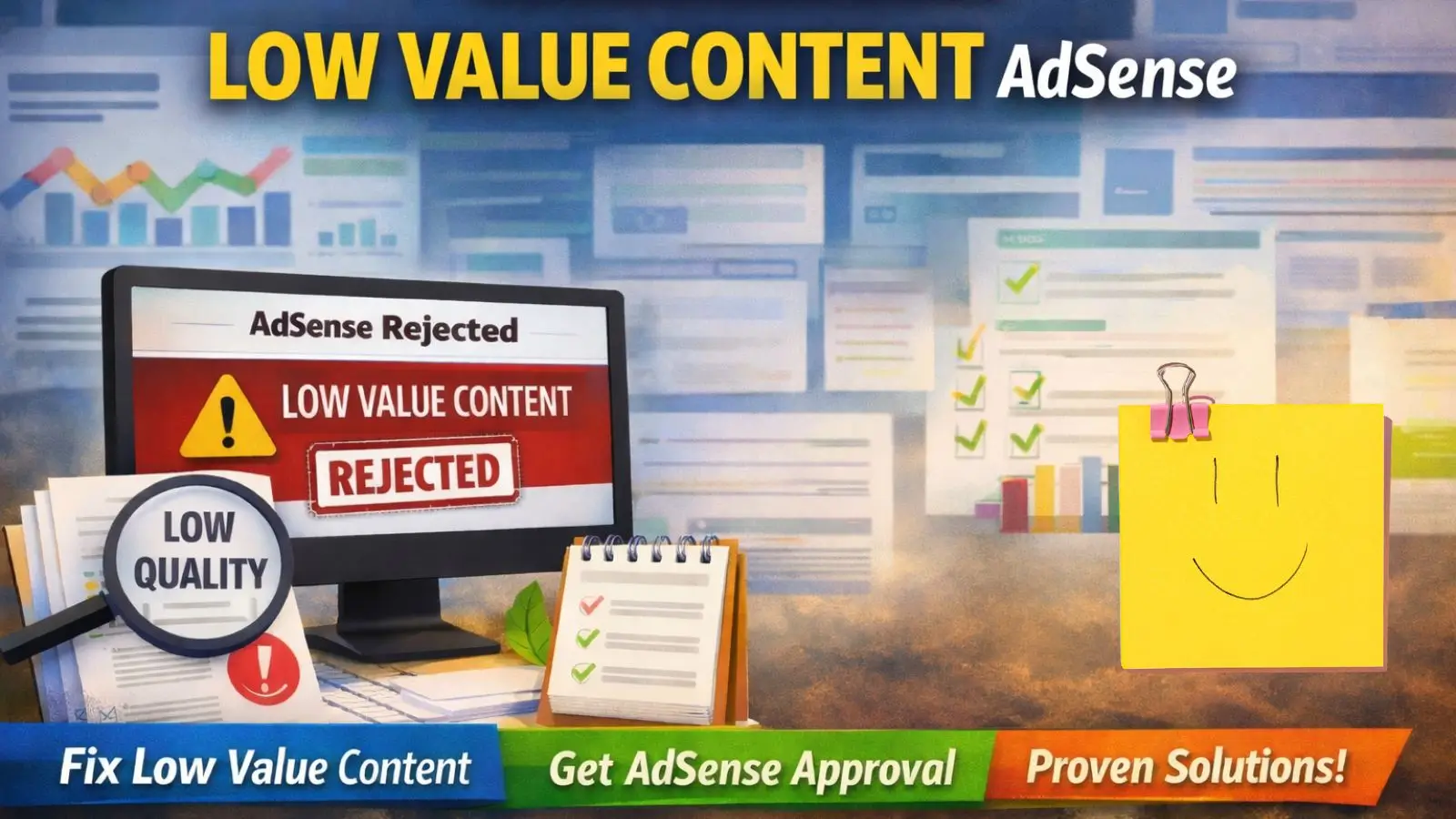
I remember staring at my screen thinking, “What do you mean, low value content? How to Fix Low Value Content AdSense I worked so hard on this.” And if you are reading this right now, chances are you just got the same message and you are feeling exactly how I felt back then. Frustrated. Confused. Maybe even a little angry.
My name is Riyan Sohail, and I have been doing this blogging thing for about 5 years now. When I first started, I collected AdSense rejections like they were baseball cards. It was bad. I would fix one thing, apply again, and boom another rejection for a different reason. But over time, I figured out the pattern. I figured out what Google actually wants, not just what the guidelines say.
So if Google just told you that your site has low value content, take a deep breath. It is going to be okay. I am going to walk you through exactly what this means and how to fix it, step by step. No complicated jargon. Just real talk from someone who has been in your shoes.
So What Does “Low Value Content” Even Mean?
Let me put this in plain language.
Imagine you walk into a store. The shelves are mostly empty. The few items that are there look dusty and cheap. Would you want to spend money there? Probably not. That is exactly how Google sees your website right now.
When AdSense says “low value content,” they are not saying your blog is worthless. They are saying that in its current form, it does not have enough substance to show ads next to. Advertisers pay Google real money. They want their ads to appear on websites where people actually hang around and read stuff. If your pages are thin, or if they do not really answer the question someone was searching for, Google sees that as a risk.
It is not personal. It is just business.
Read More: How to Use Samsung Pay in 2025 (Step-by-Step Guide)
Why Does This Happen? Let Me Tell You What I Have Seen
Over the years, I have worked on so many websites—my own, and later helping friends and clients. And almost every time someone gets this rejection, it comes down to one of a few things.
Sometimes the articles are just too short. I get it. When you are starting out, you think, “I will just write 300 words and publish it. Done.” But here is the thing: a 300-word article barely scratches the surface. If someone clicks on your post hoping to learn something, and they finish reading in two minutes and still have questions, that is low value.
Sometimes the problem is that the content sounds like everyone else. We have all done it. You look at what the top blogs are writing, and you kind of rewrite it in your own words. But if you are not adding anything new your own experience, your own opinion, a story only you can tell—then your article is just noise. Google has enough noise.
And sometimes, believe it or not, the problem is not even the articles. It is the website itself. If your menu is broken, if your pages load slowly, or if you do not even have an “About Me” page, the whole site looks unfinished. Google does not want to send its users to a half-built house.
How to Check Your Own Content (Without Any Fancy Tools)
You do not need a paid tool or a “low value content checker” to figure this out. You just need to be honest with yourself.
Go to your website right now. Pick any article. Read it out loud. Yes, out loud. It sounds silly, but it works.
Ask yourself: If I knew nothing about this topic, would this article actually help me? Or would I leave and search again?
Look at how long the article is. I am not saying every post needs to be a novel, but in my experience, posts that actually help people usually end up being somewhere between 800 and 1500 words. Why? Because it takes that many words to explain something properly, to give examples, to cover the questions someone might have.
Also, just check the little things. Are there spelling mistakes? Does the formatting look messy on a phone? These small things add up. They make the site feel cheap, even if the ideas are good.
Read More: 5G vs 6G: Key Differences, Timeline & What to Expect by 2030
How to Fix Low Value Content AdSense Rejection (The Real Way)
Alright, let us talk solutions. This is not about tricking Google. This is about making your website genuinely better.
The first thing I do when I am fixing a site is what I call a “content audit.” I go through every single post. If a post is weak, I have two choices. I can either make it better, or I can throw it away. Most of the time, I try to make it better. I add more details. I add a personal story. I make sure the person reading it walks away feeling like they actually learned something. But if a post is truly beyond saving—like a 200-word ramble about nothing—I just delete it. No hard feelings.
Next, I look at originality. This is so important. People connect with people. So if you are writing about a topic, find a way to make it yours. For example, in this article, I am telling you about my own rejections, my own frustrations. That is something only I can share. You can do the same in your niche. If you have a food blog, tell me about the time you burnt the cake and had to start over. If you have a travel blog, tell me about getting lost in a new city. Those stories? Google cannot generate those. Those are high value.
And please, please make sure you have the basic pages. A Privacy Policy page. An About page where you actually introduce yourself. A Contact page. These pages show that you are a real person running a real website. It sounds simple, but you would be surprised how many people skip this.
What About Traffic? Do You Need Visitors to Get Approved?
This is the question everyone asks. “How much traffic do I need for AdSense?”
I will tell you the truth. There is no magic number. Google has never said, “You need 1,000 visitors a day.” I have seen websites with almost no traffic get approved because the content was just that good. And I have seen websites with thousands of visitors get rejected because the content was thin and the site was full of ads already.
Stop stressing about the traffic number. Seriously. Focus on the content. When your content is good, people will share it, Google will notice it, and the traffic will come. It is a slow process, but it works.
Does Google AdSense Accept AI Content?
I know everyone is talking about this, so let me give you my honest take.
Yes, Google accepts content that was made with AI. But here is the catch: they accept good content. They do not accept cheap, robotic, copy-paste content.
If you use AI to write an entire article and just publish it as is, I promise you, it will feel lifeless. It will repeat itself. It will be boring. And Google will flag it as low value.
But if you use AI like a smart assistant—to give you ideas, to help with an outline—and then you sit down and rewrite everything in your own voice, adding your own stories and personality? That is different. That is you using a tool to work faster, but the final product is still human. That works. That can get approved.
A Simple Way to Think About Fixing Your Site
If you want to fix the low value content issue, just ask yourself one question before you hit publish on anything: “Would I share this with a friend?”
If the answer is no, do not publish it. If the answer is yes, you are probably on the right track.
Go through your old posts with that same question. If a post is not something you would proudly share, either fix it or let it go.
My Last Piece of Advice
I know getting rejected stings. I have been there more times than I can count. But here is the thing I learned: that rejection is not the end. It is just someone telling you that you are not ready yet. And that is okay. You can get ready.
Take a week. Fix your articles. Clean up your site. Add your story. Make it something you are proud of. Then apply again.
I really hope this helps you. If you ever want someone to just take a quick look at your site and tell you what might be wrong, you know where to find me. Sometimes a second pair of eyes makes all the difference. Keep going. You will get there.